Wednesday, October 21, 2015

10/17 - Pre-field trip and "pelagic" birding

7:00 AM

I don't know why this seemed really late in the morning to be out looking for birds.  I've gotten so used to early starts, maybe, trying for bird songs, owls and game birds in the road.  Still, it was just getting light when MaryFrances Mathis pulled up to the parking lot at the Salmon Center at the Mary Theler wetlands.  After the pleasant good mornings, she paused, "Can I ask... what are we doing out here this early?"


MaryFrances and I scan for Meadowlarks at Theler
I don't know when it happened, but I became a morning person at some point in my life.  Even this post is getting typed at 5 AM and I already had my breakfast!  But not everyone is a morning person, so I had to create reasons.

"Um... Hey!  Look - Greater White-fronted Geese!"  I deflected the attention from the overeager member of the birding twosome to a pair of geese circling and honking overhead.  Under normal circumstances, these code 3 birds would be a pretty good find, but I've had them this year, and MaryFrances also had come for other targets.  She is one of a handful of birders who has tracked down 175 species in every county in the state.  Mason was one of her more difficult counties, and she was after one of the targets I was here for as well - Western Meadowlark.

Meadowlarks sing beautifully, and often sing early in the morning, although in mid-October, not much is singing at all!  We walked towards the boardwalk in search of any blackbirds to pick through, and I kept an ear out for pheasants along the way.  Pheasants have been a funny species this year.  There were some in the early winter... none that I had heard of through the spring and summer, then suddenly a bunch of them in October.  Pheasant release programs had to be responsible for a lot of them, but with these birds on nearly everyone's list, I was hoping to find one and not worry about how it got there quite as much.


Fall comes to Theler
We got talking about Pete.  Both MaryFrances and I had birded a good bit with Pete Fahey in the last few years before he passed last Christmas Eve.  Pete was a pretty damned good birder, and has a county record himself (Fresno, down in California).  I think he would have approved of this year.  Pete came to Washington from New Jersey via California, and he had a lot of East Coast in him.  East Coasters are trained, I think, to be a little more intrusive and inclusive than people out here. 

I wouldn't say that I've invited myself into people's homes, boats and golf carts per se. (Well, the Biser's might have been an exception) but what I've usually done is found ways to make people want to invite me in.  I don't know if it's charm or simple B.S., but it's made for a great year.  Pete did a lot of the same and ended up at our place for dinners and birthdays more than anyone I'd known for so short a time. 

MaryFrances and I picked up a Long-billed Dowitcher, made our way back to the car and decided it was time to meet up with Mark Oberle and get ready for a boat trip.

The Mason County Pelagic Society


Okay, it wasn't a huge group, but it was probably the first time a boat trip has been undertaken with this much focus.  Mark Oberle is the parent of a young man that I both taught and coached (back in my track coaching days!).  He has a place on Treasure Island (the name used by the people who live there, although your map may have it as Reach Island), and a 17 foot Boston Whaler that he had suggested might be put to use during my big year, and the timing had finally worked out!

Through the forest to Case Inlet from the Oberle's deck
I followed the directions to Mark's and briefly landed in the wrong driveway.  It is the kind of place where that leaves one feeling uncomfortable!  Despite any intrusive themes I've had going this year, I've kept clear of trespassing!  Well... intentional trespassing.  MaryFrances and I got ready to go - gloves, hats and rainproof gear went on, and I realized that it was kind of sort of my first pelagic trip.  I mean... this was not out to sea.  Not the SEA sea, but we were going to be in a boat cruising through salt water in search of birds not easily found from shore.  Most importantly, I wasn't prepared for any truly poor weather in my jeans.

Shoving off
We didn't need to be ready for more than a sprinkle, it turns out.  We helped Mark get the boat aimed down the boat ramp (not an easy feat!), and set out under cloudy skies.  With the tide out, we went under the bridge to Stretch Island (where there is a State Park - haven't been there yet!), then properly into Case Inlet.

As we went, most of the birds we encountered were Common Loons, Surf Scoters, and the occasional Red-necked or Western Grebe.  The first treat as we headed down Case Inlet was a Rhinoceros Auklet.  This was a tough bird during the year, although I had seen one while kayaking from Boston Harbor to Hartstene a few months back.  MaryFrances and I were both keen on finding a Common Murre, and she also needed Marbled Murrelet and Brandt's Cormorant.  There are some birds that are just hard to find in Mason, and this trip was a good shot at a lot of them.

We continued down the East side of Hartstene Island (Case Inlet), then rounded the corner where we could see into Thurston.  At one point, I'm pretty sure the call "Follow that cormorant!" went out, and we eventually got a cormorant to wheel around our boat.  The stocky dark bill showed that it was a Brandt's!  We had more Pigeon Guillemots, and went past a buoy with more Brandt's and Pelagic Cormorants before heading to the end of Dana Passage and up to Pickering Passage.
Pelagic and Brandt's Cormorants - Dana Passage (photo by Mark Oberle)

Rhinoceros Auklet (photo Mark Oberle)
Pickering Passage runs the entire shoreline of the mainland from the southern tip of Squaxin to the north end of Hartstene.  It was neat to see Squaxin and Hope Islands up close.  The shore in many places had steep embankments where Pigeon Guillemots surely nested, and beautiful madrone trees seemed to be all along many stretches of the shore.  In the end, we found several more Rhino Auklets, but nothing new for my own list.  The other big highlight of the trip was a Peregrine Falcon diving towards the wake of our boat as we passed the bridge from the mainland to Hartstene.

I... just loved this.  I love being on any boat.  Period.  But this allowed me to take the map of Mason and actually nail down the nautical parts.  It's much different than viewing the water from different isolated spots on the shore, not to mention how close you can get to the birds.  Simple as it seems, I think these were life looks at close up Rhinoceros Auklets.   We got the boat back onto the trailer and back to Mark's place where we sat and ate our lunches before heading back on the road around 2.
The author makes a rare appearance in his blog - he is pretty hamn dappy because he is on a boat (photo Mark Oberle)

Hunter Farms

phew
Oh wow.  And it's not like I hadn't been to a pumpkin patch before, but... a weekend in October was a crazy time indeed to try to walk the grounds at Hunter Farms in search of a White-throated Sparrow.  I was happy enough to have gotten parking within a quarter mile of the lot, but it was pretty noisy as we began our search of the garden!

Pumpkin business in full swing!
The garden near the parking lot at Hunter Farms has been full of sparrows for a couple months now.  The Savannah's have slowly disappeared, and recently a White-throated Sparrow was found in with the Golden-crowned.  We went back and forth and in amongst the rows of spent tomatoes and cabbage, looking for the little guy.  Our first bird of interest was a Lincoln's, but the day was running long, and Mary Frances gave up on the bird eventually, deciding to head out to the Skokomish Valley in search of other birds.

As often happens in birding, as soon as she left, the White-throated Sparrow popped up (175 for the year!) for a brief glimpse.  These sparrows are a code 4, so they just aren't recorded annually, although they may very well be around the county more often than that implies.

I usually make sure to buy something on the way out the door, but... it was pretty crazy!  I passed on ice cream, and instead went running after American Coots at Lake Isabella.

&%$#@ Coots
 
Isabella Lake from the public fishing access

See... the thing is, it's been hard to find these little guys.  American Coot is a code 1 bird in the county.  Expected on most days on a field trip.  Think like... American Crow.  That easy.  But the code is of course a little questionable because there are actually few places to reliably find coots, and there are people who despite efforts can't seem to find them.  That said... Matt Bartels had found a dozen or so of them on Isabella Lake while scouting for the field trips planned on the weekend.

This turned interesting.  I started off looking for the way to get to the State Park, or onto Delight Park Road - I simply hadn't been to Isabella Lake State Park, only having looked at it from the north side of the lake.  I got off on the road to Matlock, and drove a little bit before realizing I had gotten off too early.  I grabbed Shelton Valley Road (which was gorgeous farmland - very birdable) and took it down to Cloquallum.  My map shows a road going to the backside of Isabella Lake from the north.  No road does this.  Just letting you know.

Several attempts and turns later, I made it back into Shelton and got onto Highway 3.  This was the fix.  If you take it right past 101 and take a right, you eventually hit the turn for Delight Park Road.  Driving past the state park brings you to the fishing access where the coots had been seen.

The view of the lake from the state park
I underestimated how far out these guys would be, and scanning in binoculars, or even with the scope at first did not bring me any luck.  A couple that was paddling in and around the lily pads to the west end of the lake may have been moving them to a different spot?  I don't know.  I just knew that I had been trying for these birds everywhere without success and that several birders had seen them here in the last few days.

Assuming they had moved, I went to the state park and walked to the water through the park.  Five minutes of walking brought me to a nice place to sink in the mud while peering through a tiny opening in the shoreline shrubbery.  At this point, I hung it up and went in to Shelton to meet up with Kevin Black.

Evenin' friends!

Kevin Black and I accidentally became friends when I was doing the 39 counties blog.  The year ended and he nearly cussed me out for ending the blog.  We have gone out and birded in several corners of the state, including the Okanogan, Yakima, King County where I got him over 100 species, Franklin where he got me over 100, and down in the Southeast corner of the state on a great trip with the aforementioned Pete Fahey.  He's just one of the good ones.  I don't think anyone that has met Kevin would argue with that assessment.

We sat down at Grove Street Brewing in downtown Shelton where the beer and service were great and the food was okay.  We laid out the plans for the next day and talked about some of the goals for Sunday.  Kevin's biggest goal was to get a Mountain Quail.  It would be a life bird for him, and would be a different kind of life bird from what he has been getting in the last few years.

Kevin is not alone in that he enjoys a good chase to see a bird that might not be seen again in his lifetime.  In any given year, several such birds come through the state, so he's been on his toes chasing after Dickcissels, Caracaras and even on this day was struggling because a Prairie Warbler had been seen up in Clallam County.  Mountain Quail is one that isn't going anywhere, but I really hoped he would be able to find one on the trip, so we decided to add in a side trip - just a mile or two across the Mason County line on Sunday to look for the little dudes.

We wrapped up and made our way back east to Mason Lake and the home of Wendy Maki.  Wendy and I became friends on Facebook shortly after she posted California Quail on eBird.  I contacted her to get more information, and after a few picture exchanges, we determined that the birds at her feeder were "only" Mountain Quail.  Not a bad yard bird at all.  Since then, we had talked about me stopping in to check out the birds at her home.  There's still one that I need (pheasant), and there are a few that she wanted help identifying. 

Kevin and I walked in on this:
Warm welcome
The Maki's have a big wall painted with chalkboard paint and they do it up when they have company.  This time it included some of their favorite birds, and the Western Meadowlark that she knew I was hunting for.  The Oregon Duck was missing from the picture, but their house was happy by the end of the evening, as the Ducks beat my Huskies.

We actually had a great evening looking through bird pictures together - enjoying the ones that had taken nest near the Maki home, and helping with some identifications.  We learned that they often have Great Horned Owls calling from their home, so I added the east end of Mason Lake to my list of places to look for them.

We got a call from Margaret Snell with some trip questions, and then found ourselves ready for bed.  I was pretty wiped after a long day, but am looking forward to getting back soon.

But what does soon mean?  I only have a couple more months left in the county this year, and I'll probably be taking on... well okay, I thiiiiiink I'm going to bird in Chelan County next year. 

Sunday, October 11, 2015

Birds for thought - October to the finish line

Well then...

...At this point, if it's not a breeder or extirpated, it's on my list of targets the rest of the way out.  I have a massive weekend coming up:

Saturday October 17th:  Boat trip around Hartstene, trip to Theler, pheasant hunt, quail hunt, maybe another search for birds in a secret location.  Busy day.

Sunday October 18th:  WOS field trip.   I'm bringing a car of people up into the Olympics, down Hood Canal to the mouth of the Skokomish.  Two other trips are blanketing the county.  We meet at lunch and figure out what we need to chase! 

So here is the list taxonomically of the possibilities for the rest of the year.  I'm at 174 birds, and the record for Mason County in a year is 179, so it's totally in reach!

Geese:  Ross's Goose (code 5), Emperor Goose (code 6? never been seen)  

It's the right season for these birds, so it's just a matter of hitting Hunter Farms and Theler and keeping an eye out for interesting geese.

Tundra Swan:  They were here earlier in the year.   I have a hunch that these are more common than their code 5 implies.  Skokomish River Valley all the way up to the delta.

Ducks:  Eurasian Wigeon (2), Blue-winged Teal (3), Cinnamon Teal (2), King Eider (5), Long-tailed Duck (3), Ruddy Duck (3).  

The wigeon is going to happen.  I just need to keep looking, and I'll actually be surprised if it doesn't happen on the next trip.  The teals... there is a chance I'll get them this weekend, and then the chances are probably dried up.  Someone saw them in the last week on Cranberry Lake!  I am getting the feeling that November, of all seasons, is going to be the one where I get in a kayak and paddle across Hood Canal to look through the ducks for a Long-tailed.  Ruddy Duck is like a phantom.  I have no idea where to look, but that trip could get me one.  The Eider is impossible, but would be possible at the Skokomish Delta.

Game birds:  California Quail (4), Wild Turkey (5), Ring-necked Pheasant (2)

I'll be checking for the quail at Sanderson and the pheasant in like... three places now.  Hurley Waldrip Road, Mason Lake and Theler Wetlands.  Throw Hunter Farms in there.  The turkey isn't happening.  I couldn't imagine seeing any that I could county, even if they were out there in the past.  No solid credible leads.

Loons and grebes:  Arctic Loon (5), Yellow-billed Loon (5), Clark's Grebe (5)

All unlikely, and two of them possible products of optimism.  On a scale from one to ten, my general comfort with identifying a Yellow-billed Loon is pretty good, maybe an 8 to ten depending on distance.  Clark's Grebe would range from 3-7 depending on the grebe itself and the distance.  Arctic Loon... like zero.  Fingers crossed for the loon.  An area I haven't properly studied is Case Inlet and Oakland Bay, the big bay that runs right up to Shelton.  I'll have it on my rotation if I can squeeze it in.

Pelicans, herons and whatnot:  Brown (5) and American White (5) Pelicans are both possible, and I feel like the trip I'm leading Sunday would be as good a time and area as any.  American Bittern is a frustrating one in this count for a lot of birders.  I guess it can be there year round, and I think the area around Kamilche should be decent.  Maybe a November trip to Skookum Inlet Natural Preserve (with boots... large boots) would give me a good chance to find this code 4 bird.  The white egrets, Great, Snowy and Cattle are all code 5.  Great Egrets... they'll be properly moved in given a couple years! I wouldn't be surprised by one nearly anywhere.  Cattle Egrets would be a fun new state bird.  They will be one of the reasons for checking farmland.  Black-crowned Night Heron (5) could basically show up wherever Bitterns could... right?

Raptors:  Northern Goshawk (4), Red-shouldered Hawk (5), Swainson's Hawk (5), Rough-legged Hawk (4) and Golden Eagle (5).

I think it's late to put Broad-winged Hawk in there, but it brings up the whole theme of raptor migration.  It's happening!  We are on the tail end of it for sure, so the birds that migrate earlier have become very unlikely, but my trip in the mountains next Sunday will include some time looking up.  The goshawks are one of those that could show up any time.  Golden Eagles are more possible on the northern end of the county, I think, but have also been seen near Church Creek.  Rough-legged Hawks fall into the same category as Cattle Egrets above.  They are a reason to head out to Matlock perhaps, and to check the other farmland I've been watching so carefully.

Coot-ish things:  American Coot (1), Sandhill Crane (4) Sora (4)

The first was seen at Lake Isabella in the last week, and cranes have been heard this month migrating overhead, including a Mason sighting.  A little late for the cranes, and it's just getting good for the coots.  I was told there was a hard freeze that would have scared off some of the coots last winter, so I'm hopeful on them.  Sora is still a good shot for this trip coming up.  I think we have had Virginia Rail in.. 4 or 5 places in the county now, so it makes it possible to try those spots again. 

Shorebirds:  American Golden-Plover (5), Pacific Golden-Plover (5), Willet (5), Ruddy Turnstone (5), Black Turnstone (4), Red Knot (5), Sharp Tailed Sandpiper (5), Sanderling (4), Rock Sandpiper (5), Pectoral Sandpiper (5), Red-necked Phalaraope (4), Red Phalarope (5)

Tough all the way around.  The Pectoral and the Red-necked Phalarope are the ones I'd wager on.  The former will be looked for on Saturday, after which time it becomes less likely and Red Phalarope becomes more likely through the rest of the year.  There are a lot of them here that I think of as Alki Birds.  And... come to think of it, I don't see Surfbird in there.  So that's the next new shorebird that will get added in the county, by the way.  Maybe I'll find some rocky shoreline in Mason and it'll have half of the birds listed.

Parasitic Jaeger  (3).   Yeah... a little late on this one, but it's not toooo late.  One was seen at the Skokomish Delta a few weeks back, but it could be seen on Saturday or Sunday for me.  They've been seen regularly in King County this week.

Alcids:  Common Murre (2), Ancient Murrelet (5), Cassin's Auklet (5).  All possible, I suppose, on the boat trip I'll be taking, but a bit early for Ancient, which has only been seen once anyway.

Gulls and Terns:  Black-legged Kittiwake (5), Sabine's Gull (5), Franklin's Gull (5), Heermann's Gull (5), Glaucous Gull (4), Common Tern (4).

Looking for black heads on all gulls these days, and for the classic coloring of a Heermann's of course.  Common Tern is a bit late, but not impossible on the boat trip, and Glaucous would be later... I think?

Owls:  Snowy (5), Spotted (3), Short-eared (5)

I'll have fingers crossed for a spottie in dispersal, but I won't cross them hard.  Snowy or short-eared would be more  likely, oddly enough.  Theler seems as good a place as any for either, which means they'd likely be found by others if they do show up.

Woodpeckers: I'm going out on a limb and saying I'm not going to get any woodpeckers.  Acorn and Three-toed are on the county list (and the idea of three-toed in the high Olympics in Mason is mmmm... but my ankle didn't go there).  Lewis' Woodpecker isn't on the county list yet, but I would expect it (or an Acorn for that matter) to show up at that Oak Patch near Camp Spillman.

Flycatchers:  Western and Eastern Kingbirds are code 5.  I like Tropical better, but it's not on the list.  Say's Phoebe is on the list at a 5, but a Black or Eastern would be just as likely, I suppose.  I actually like George Adams hatchery for a Black Phoebe... I'll have to think of other spots.  That's tough.  Basically, the like ponds with structures.

Corvids:  Black-billed Magpie (5), Clark's Nutcracker (5), Blue Jay (not listed)   My money is on the Nutcracker to be seen before the other two.  They're in the Olympics and drop down from the mountains in the winter months.  Maybe not a super cold winter, though, so...

Little teeny birds:  Mountain Chickadee (5), White-breasted Nuthatch (5), Rock Wren (5) Canyon Wren (not listed).   All pretty unlikely, but my imagination would have these showing up at a feeder in Shelton, at the Oak Patch, at Lake Cushman, and... okay I don't have any ideas for Canyon Wren.  Even Sunnyside Road would be a stretch.  I'll say Sunnyside Road.

Thrushes:  Mountain Bluebird (5), Townsend's Solitaire (3)

Bluebird would be random and welcome.  The Solitaires have been seen in Clalllam in the last week, so they'd be possible down this way, I figger.  Roads have been pretty clear.

Lapland Longspur (5) and Snow Bunting (not listed)  A little late for the longspur, but not a lot late.  The Snow Bunting is going to show up at the mouth of the Skokomish, so I'll go get that by kayak in November.

Warblers:  Only thing I would expect at this point that I haven't seen already isn't on the list yet:  Palm Warbler.  Wouldn't that be swell?

Sparrows:  American Tree (5), Swamp (5), White-throated (4), Harris' (5)  

Hunter farms, the Skokomish Valley and Theler seem like the best bets here, but I wonder if any other little corners like Hurley Waldrip might have good sparrow patches.  Swamp!  That's got to be Theler, I suppose, although that's another where I like the back side of the George Adams Hatchery.  My other thought is to have one of the local papers run a story, and have them include wanted posters for these guys.

Blackbirds:  Rusty (not on the list), Common Grackle (5), Western Meadowlark (3), Yellow-headed Blackbird (5)

I've got to pay more attention to those blackbird flocks.  Theler, Hunter Farms, Skokomish Valley.  Basically those sparrow spots.

Finches:   Gray-crowned Rosy-Finch (5), Pine Grosbeak (5), White-winged Crossbill (5)

I'll keep ears open for the first two especially when I head up high on Sunday.  I so wish I had made it up higher on Mount Stone, but that mountain was ouch.

So there's my whole hand on the table.  Nearly all the birds I'm missing.  At least now when I find them, it'll look like I was expecting them!


Saturday, October 3, 2015

Plus five! 10/1 in Mason County

I had ideas for a title, "The Hunt for Redheads in October", "Tim wakes up and smells the tertials", "Betting on a Longspur", but I don't know if any of them really fit.  That said, this was a trip that was kind of the second of my two September days, and I went ahead and kept formal track of species, so it was a big day to boot. 

The way it always starts!

Seven Eleven has been awfully good to me, although I was sad at 4:30 AM that they didn't have the juice blends they usually sold at such a better price than anything at Starbucks or anything that rhymes with Shmodwalla.  The pumpkin spice coffee almost made up for it.  It let me know fall was here, and I really do love the season.  Apple cider, pumpkins, leaves, crisp air... and for my birding, it was time to make a last attempt at some migrants, and an early attempt at some of the winter birds as they returned.
Oak Patch Lake - early

Camp Spillman

I made it to Camp Spillman some time around 6 AM, and briefly tried the roads for Ruffed Grouse.  It seemed like doing this in the dark wasn't the best idea, so I just parked it by Oak Patch Lake and waited for civil twilight.  Civil twilight is one of my favorite times, and probably one of my favorite ideas.  It's the time in the morning before the sun comes up when it is bright enough to walk around. The very start of civil twilight in spring is amazing! 

I'd go here if I was a grouse
This morning, the lake woke up with a Great Blue Heron, and a bird that was nasal... it had me thinking coot (but turned out to be Pied-billed Grebe when it finally got light enough), which would have been a new bird.  The next birds to join the chorus were Northern Pygmy Owl and Barred Owl.  I enjoyed them for a while, and listened to the sparrows waking up.  Once civil twilight rolled around, I realized that I had Pied-billed Grebes, and decided to drive the roads for my grouse.

Grouse!  Within a few hundred feet of driving, a Ruffed Grouse (170 species for the year) took flight from the side of the road after a moment in my headlights.  It disappeared from the road, becoming as invisible as the other thousand Ruffed Grouse I had certainly driven by this year.  I kept driving the roads and found mostly Varied Thrushes, with some American Robins mixed in.  On the way out, I added a Cooper's Hawk and a few Gadwall at the lake.

Dewatto... say it like Keanu Reaves, come on!  D'wahhh tohhh...  Now try not to say it like that next time/forever.

Spiderwebs and dew
I really didn't need to go to Dewatto.  Nobody had just seen an amazing bird there.  It isn't a place that has a history of people seeing X, Y or Z.  I just hadn't been there before, so I kind of did have to go there.  I made a few stops and side trips along the way.  Blacksmith Lake sounded like a good idea - Tahuya-Blacksmith Road is one of the major roads through the area, so getting to Blacksmith sounded nice.  Unfortunately, many people thought that Blacksmith Lake sounded nice, they built houses all around it, and I had no view. 

On the way to Dewatto, I passed farms, fields, rivers and marshes.  It was great habitat, and may have been interesting to visit back in the spring!  Golden-crowned sparrows and a Gambeli's White-crowned Sparrows called from the fields before I finally got to the mouth of the Dewatto River. 

(Shut up and just show the picture, Tim!  Okay!

Shhhh....)

(Thank you!

... no problem!)

Dewatto Beach is around the corner from the mouth of the river, and I got to see a few saltwater birds - Common Loon, Horned Grebe, Pigeon Guillemot, Double-crested Cormorant and a few gulls. 
Pigeon Guillemot nests near Dewatto

Dewatto to Tahuya

Don Lake
I meandered up the road a bit, and found a turn for Don Lake.  I was game at this point, having American Coot and Northern Shoveler on my needs list still.  In my most optimistic dreams, there were Cinnamon and Blue-winged Teals waiting for me on some of these lakes as well!  Nothing on the lake - nothing!  I got out and enjoyed some of the other passerines, including Yellow-rumped Warblers, Red-breasted Sapsucker, and Downy Woodpeckers.  It was pretty enough, but it didn't seem like there was anything more to see, so I got back on the road from Dewatto to Tahuya.

I passed another lake on my left, the Tahuya Peninsula is full of these little lakes - and pulled over to take a look.  This one was Tee Lake, and it turned out to be a good stop!  First I found a Northern Shoveler (171) sitting in the middle.  I was sorting out the plumage on it... ducks are in all kinds of odd plumage this time of year... when the shoveler next to it dove.  Weird...  Then I remembered that Shoveler's don't dive!  Hmm...

Just good enough! - Redhead, Lake Tee
I looked at it again, and saw what seemed like a Canvasback at first.  The shape seemed wrong and I dug out the field guide. 

!

I pulled the car around and got onto the shoulder, got the scope pointed at the bird, and got what may be the crappiest picture of a Redhead (172) in the history of birding in the county.  Digiscoping has been kind of hit or miss for me, so I was happy to get one that actually showed me the patterned end to the bill.  This was a Code 4 bird that wasn't even properly on my radar, and an awesome surprise.

Tahuya to Belfair
 
Tahuya River Mouth

Tahuya itself was pretty socked in with fog.  As I dropped down from Tee Lake to Tahuya, it got thicker and thicker.  Hood Canal was actually gorgeous like this, even though I had no chance to see very far out into the water.  Even so, I had a couple of nice stops.  One was at Summertide Resort.  I had parked at the dock, and was met by the owner as she made her way out of her home to open up for me.  She let me go out to the dock as long as I didn't block the boat launch.
Foggy morning on Hood Canal

I didn't find any birds to speak of, but it sunk in... these people rent kayaks!  I looked out into the fog, and tried to imagine what was on the other side.  Heading back in, I asked about rentals, and just for fun asked how long it would take to get to the other side of Hood Canal from there.  "Oh, not long.  We're right across from Alderbrook.  It might take a couple hours if you really dilly-dallied."  My eyes lit up, and I looked again at the fog, then back at the owner "Not today.  But... I'll be back!"  I promised, imagining myself crossing the water through all of the grebes, loons and cormorants... maybe with some Common Murres passing me?  Time's running out, but I love this idea.

The other interesting stop came after I'd pulled to the side of the road to look at a loon.  For the... twelfth? twentieth? time this year, I was invited to someone's home to look at birds.  The gentleman who had been clearing out some furniture from his vacation home offered to let me view from his deck.  Now... it was still foggy, so I really didn't see anything at all, but I've loved every time I've been welcomed like this.

Belfair State Park
Cackling Goose - Belfair State Park

This place took a lot of my time!  There were so many ducks back in town, and gulls, and geese.  I had to pick through a lot of birds!  I'd been staring at so many Pintails and Green-winged Teals, trying to make them into something else, when a flock of Canada Geese dropped in, along with a single Cackling Goose (173).  After enjoying the bird, I got back to the gulls.  There were a few Glaucous-winged and California Gulls, and I ended up picking out a Mew Gull as well!  Not a terribly rare bird, but just another sign that winter was coming.

I spied more ducks farther up from the main beach and walked it up to investigate.  They were mostly mallards, but there were also a dozen American Wigeons.  No Eurasians showed up, so that's still a bird that I'll be looking for as the year wraps up.  On the way back, a Merlin and a Northern Harrier took turns patrolling the beach, the Merlin scattering the birds from the beach pretty thoroughly!

Theler Wetlands 
Another repetition of this picture

It's been an awful lot of trips here, but there are just too many birds that have shown up in the amazing and varied habitat.  Shorebirds have been pretty good here, and I knew time was running out to find Short-billed Dowitchers, which had been seen off and on throughout the fall.  Today I made a bee-line for the shorebird habitat, keeping only half an ear out for interesting chip notes. 
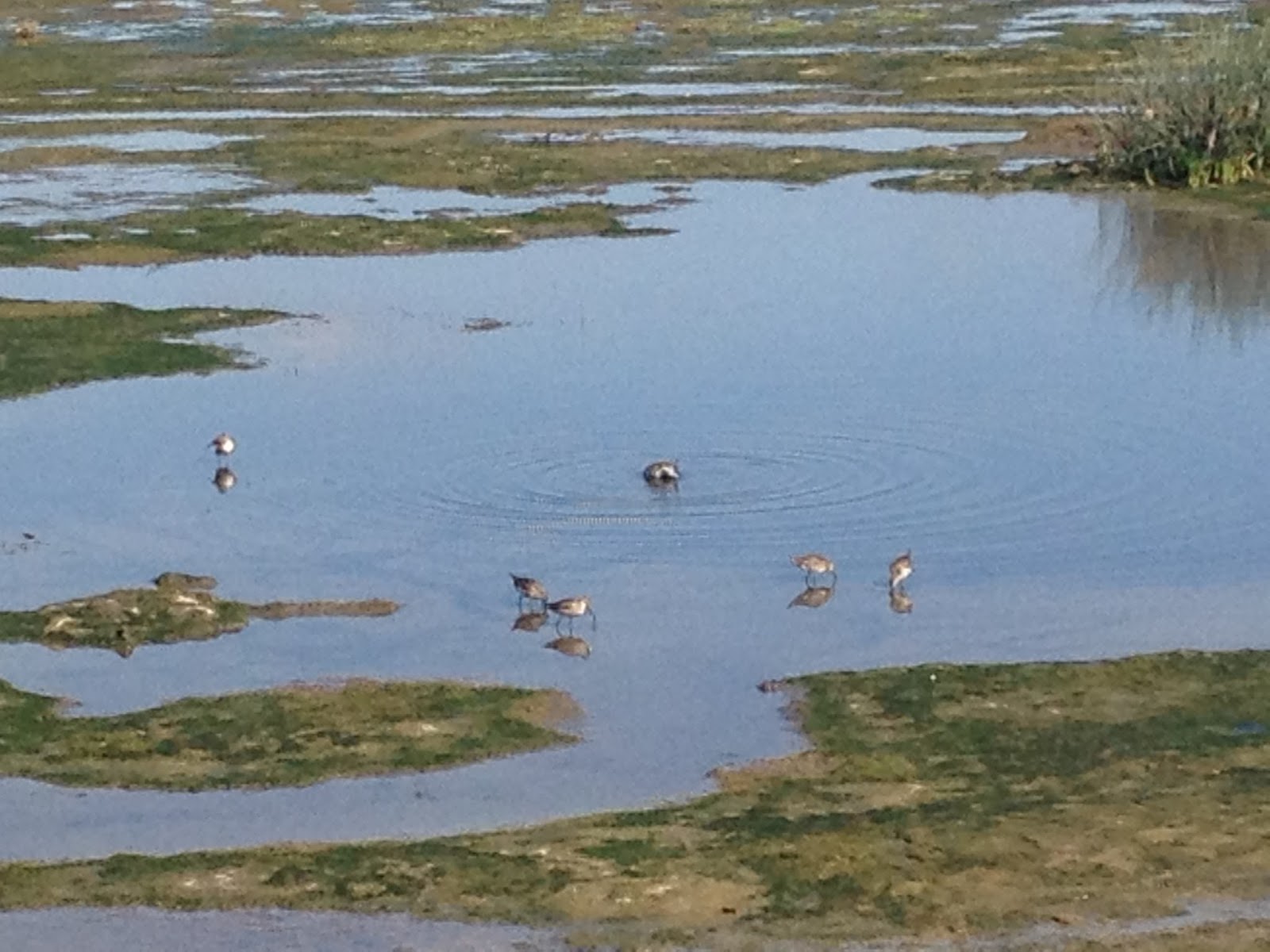
Dowitchers - both of 'em

I made it around the corner, before hitting Big Bridge (yep.  I'm just going to name it.  It's the biggest bridge there, and it's the one where 99 percent of the shorebirds have been found this year), and right there were six dowitchers waiting for me to look them over.

!

Now, I've talked about how much better my ears are than my eyes.  Call notes and songs stick with me pretty well, but feathers... I just... I mean there are so many different feathers, and where they show up when a bird is roosting... or flying... I just get confused.   The code word I have used almost universally  has been "tertials".  When people start to note the finer points of identification and field marks and feathers, I'll throw in something like, "Well, and then there's the tertials.  I mean... Just Look at Them!"

So I think (and I want to check with Alanis Morisette on this one) that it's particularly ironic that one of the trickier ID's I pulled off involved tertials. 

A few weeks earlier, I had shown up at the mouth of the Cedar River in Renton to pick up a new county bird - a Semipalmated Sandpiper.  While I was there with a few other birders, we finally nailed down the ID on the Semipalm, and had looked over a dowitcher, deciding it was a long-billed.  Before I left, Marv Breece arrived.  Marv at one point set the Washington State Big Year Record, although greater and greater levels of obsession have led to more birds from others since!

"Oh man, that's a Short-billed!"  Marv said, with little doubt in his voice.  He started to explain why, and said the word "tertial".   I tried to keep listening, but the rest sounded like the teacher from Charlie Brown.  Marv saw my face and laughed.  "Tim.  Hold on.  Do not leave!  Just breathe!"  He helped others through the ID, then went and pulled out his field guide.  He went to the dowitchers and pointed at Long-billed.  "Tertials."  he said... waiting for me to digest the word and the feathers.  His finger moved to the Short-billed and pointed again.  "Now on the Short-billed.  See?"  

I looked at the bright orange patterning on the feathers, and smirked a little, "Well, yeah, I mean... "  He cut me off and guided me back to the scope.  "OH!"  I looked back up, nodded, and then promptly passed out from the mental effort.  I exaggerate, of course, but this is one of the areas of expertise that most birders work hard on.  I've... tried?  I just feel like things haven't stuck.  But...

Dowitchers in fall
Short-billed (top) and Long-billed (bottom) Dowitchers - Theler Wetlands

I could see the birds pretty well.  They weren't far from me, and looking in the same area that Marv had previously pointed out, it was easy to pick out the orange.  I watched them for a bit, and enjoyed looking at the differences.  Thankfully I also got a few pictures!  People mess up this identification all the time, and no ebird reviewer worth his salt should simply trust any unusual sighting coming from me with the word "tertials".

Brad Waggoner, despite his disdain for The Mason, is definitely worth his salt.  We've birded before on WOS field trips, and his energy and knowledge are extensive.  He had the (unfortunate? entertaining?  both?) responsibility of following up with me on the ridiculous report I had submitted for these birds (they are a bit on the late side, and I had said something like "The tertials were just screaming "Short-billed"").

After stalling him with an equally crappy description of what I remembered seeing on the tertials, I dug out one of the pictures, and opened up a treatise on Dowitcher ID from Surfbird.com:

surfbirds.com - identification of dowitchers  

In the end, I sent this:


Hey Brad!

Theler in fall
I thought I had failed to catch an of the short-billed in pictures, but I think I have one.

Front bird looks like a Long-billed.  It does have what looks like a steep loral angle, but the tail appears to have wider black on it, the coverts are fringed in brown with a dark center, the chin appears dark, and the bill appears pretty straight.  There is no orange patterning within the tertials, and  no barring is apparent, but that may be due to the posture of the bird.  The back bird has a paler chin, white fringes on the coverts and orange tiger striping in the tertials.  It also appears to have a high loral angle and a slightly decurved appearance in the last third of the bill.  There’s no barring apparent, and the posture should show some if there was any. 

-Tim


Short-billed Dowitcher (174)

Now... not all of those field marks (as you can see from reading the article carefully!) are definitive, but still... it was nice to have a picture that showed so many of those differences apparent with birds in the same picture. 
One of many of these caterpillars seen on the walk

Chanterelles!
Exhausted, I made my way back to the car and through Belfair.  I had two bits of yumminess waiting for me in Belfair.  I first found a farm-stand that was selling chanterelles.  Unfortunately, the hot dry summer has meant that not many of these mushrooms were making their way into the market, so it was kind of slim pickings! 

Just down the road from there, I stopped in at Seabeck Pizza and ordered a slice of Hawaiian.  Holy Canoli!  They cook slices of pizza to order, and they come out with this crispy flaky crust that's just f;ldkfjeoiejejrelkjd, and the toppings are done up pretty deeply.  I'll be back.

Twanoh to Hunter Farms

From several stops on Hood Canal, I ended up finding a few interesting birds - Bonaparte's Gull, Red-necked Grebe and Western Grebes.  As I stopped at Twanoh, then Union, the number of Surf Scoters rose and rose.  It was nice to see them back!  The mouth of the Skokomish, however, was just not great.  It wasn't that there was any lack of birds, but they were so far out.  It made me more resolved to get out there in a kayak!

Hunter Farms was all ready for October.  People were working on finding pumpkins in the patch which will be open all of October.  I stopped in for ice cream, and saw licorice waiting for me in the display case, but... Pumpkin Praline?? Yes please. 
Hunter Farms - October is here!

I was directed to a gentleman in a black cowboy hat to ask for permission to walk the back fields.  I got a yep, and asked out of curiosity if he was the owner "...the family" he said after searching for the word to qualify it properly. 

The very first vegetable gardens on the way out from the parking lot were teeming with sparrows!  All I could find were Savannah, Golden-crowned, White-crowned and Song, but the numbers of them to pick through were pretty darn substantial. 

From Hunter Farms, I went across Purdy Cutoff Road, spying a Ring-necked Duck along the way.  From there, I decided to hit Sanderson Field.

 
Sanderson Field

I've had a handful of pretty good birds at Sanderson, but two were on my mind as I pulled in:  Lapland Longspur and California Quail.  I pulled in and listened again to the calls for longspurs, finishing with one of their flight calls.  I stepped out of the car, and less than five minutes later, flying over head, "Kityoo... kityoo... kityoo..."  and done.  Or... at least I'm pretty sure that was the sound?  The thing is, longspurs are almost always found on the ground, hopping around from spot to spot in the grass, and making a distinctive rattle call. 

It's not that they never make other calls, and it's not that they never fly overhead.  It's just that for  a life bird, I couldn't find a good reason to trust something that odd.  Purple Finches made a similar sound, although I really don't think their call was a good fit for what I heard.  The time of year was great for it, and the habitat seemed good, but after a half hour of waiting, I didn't get a chance to hear the calls again. 

Cue the Frozen soundtrack.... let it go!  let it go!!!

Kamilche

It took a little bit of work, but I found that there is a place to access Little Skookum Inlet pretty easily.  Port Blakely Tree Farm has a little gate off of Kamilche Point Drive, and an easy walk down to the water.  As long as you don't block the gate, it's fine to park and walk, and the view at the bottom was pretty.  I do wish I had come when the tide was a bit lower, but I had time, so I sat and waited for some interesting birds to float by.

As I waited, I shot emails back and forth with Matt Bartels and Cara Borre as we planned out a crazy idea for a field trip in Mason County in October (details to come!).  I also peeked across the inlet and realized that I had birded from the other side at David Ness's home - clearly visible from the picnic table by the water.

No new birds, and just a handful of gulls, and I decided to pack it up.  My last stop was Kennedy Creek - similarly I had a stop that was free of shorebirds, although this last stop of the day did at least have a lot of ducks and gulls - just nothing that stood out.  The day ended with a list of 71 species for the day - not bad!

Kennedy Creek Estuary

So

Five new birds for the year, and a few of them were pretty rare!  It made up for my last trip, which had yielded no new birds.  I only need six new birds for the year to break the yearlist record (and as an update... there are coots in Mason County now!).  It will be interesting to see how the year wraps up!