It should get exciting with migration coming! There are a few birds that will be leaving for sure, and that includes a lot of the birds on my last Birds for Thought post (Bullock's Oriole, Red-eyed Vireo, Lazuli Bunting). It was fun that at least one of those birds - the Black Swifts - showed up for me.
So outside of the Code 1-3 birds, what birds am I hoping might pass through?
California Quail: Still holding out hope for this one. I'll give the tree farms north of Shelton another look - although they wouldn't be going away, so this might be a search for later in the year.
Brown Pelican: Well, it could be a White Pelican too, but they are both code 5 birds - I just see that Browns appear to be moving this time of year, so the odds might be a little higher of stumbling onto one. I'll keep checking out the saltwater in Hood Canal, especially.
American Bittern: They also seem to be moving according to the abundance charts. I might not travel as far and wide looking for them as I did in June, but they will still be worth keeping an eye out for.
Northern Goshawk: I almost included Golden Eagle here too, but I don't think I'll be at a good enough elevation or rocky enough area to expect much of anything. Goshawks could show up any time!
Sora: Especially when we get to mid-late August. Possibly at Theler.
Solitary Sandpiper: A code 5 shorebird - I may have to hope for some flooded fields to increase my chances here, but Theler and Kennedy Creek could easily have one show up.
Black Turnstone, Ruddy Turnstone, Wandering Tattler, Willet: These four are all code 4/5 birds, some of which might be more likely than others, but all of which would be more likely in slightly rockier areas, I figure.
Sanderling, Semipalmated Sandpiper, Baird's Sandpiper: These peeps all seem to be coming through on the early end of migration rather than the later end, so any could show up (and Semipalm already has!). It's going to mean looking through flocks of peeps all the more carefully... something I suck at.
Pectoral Sandpiper: As above, but they are just so much bigger - should be easier to pick out, and they are a little bit later - should be laaaaate August into September.
Red-necked Phalarope: This is one of the main reasons I would like to get into the south sound during August. These guys are in Puget Sound, and at a code 4, should be findable. It may be that they are annual, but just hang about in inconvenient places. So much birding in Mason is simply done at Theler... it will be interesting to get out there and see what this end of the sound holds. Parasitic Jaeger is a code three bird that I figure would be easier down here as well, along with Murres (code 2) and Auklets (code3). This season should give some good overlap where all of them could be found!
Sabine's Gull, Franklin's Gull, Heermann's Gull: All possible in this window, and a little easier for me than, say... a Glaucous Gull.
Common Tern: My eyes are open, but these are better in September and seriously on the decline in Puget Sound, I had thought. They are listed at a code 4, so I need to be ready for these little guys to show up. Again... Puget Sound more than Hood Canal is my understanding of where to try for them.
Western Kingbird: I've had these in King County in the fall - a rare thing, but possible! I think earlier in the season there could be Eastern migrating through as well.
Bank Swallow: I'm pretty dialed in on the calls for these guys, so I'm ready to fight through the cryptic juveniles and maybe find a migrant Bank Swallow this fall. Tough to find by field marks alone, so the calls should help me find candidates.
White-breasted Nuthatch: Ha! Impossible, but I'll look in the oak patch on Tahuya anyway.
Tennessee Warbler: Of course! Right? I'll just pretend we are in Washtucna and look carefully at those warblers as they come through. This is the season to find weird ones, and this would be one of the most expected weird ones.
Vesper Sparrow: I think someone had a migrant recently. Eyes and ears open for these guys even though they didn't nest this year.
Yellow-headed Blackbird, Western Meadowlark: Each has made a brief appearance this year. The Meadowlarks, I just realized are a code three! Should be findable, but I may need to be at Theler a bit more - not a problem with the shorebirds coming through.
Pine Grosbeak: I have one more trip to Olympic National Forest to look for Ruffed Grouse and whatnot. I think this may be as good a possibility as any of the code 4-5 finches.
So the wish list has changed! But it should still be an interesting time to look for birds!
Friday, July 24, 2015

Wednesday, July 22, 2015
7/12 A half-morning of birds
Tahuya Peninsula
I woke up at the Biser's early and iced my sprained ankle a little. The previous day had gained me a single new species for the year - an unexpected Black Swift! I had missed Ruffed Grouse in the morning, and thought I'd try spots on the Tahuya Peninsula - driving some more gravel roads in hopes of catching them on the road in the morning.
 I made a stop at Starbucks just as they opened at 5, then headed up Elfendahl pass road towards Camp Spelman. This gravel road led to several camping and fishing sites, so traffic slowly increased during the morning. Not much, just a car hear, a fisherman there, but it was interesting to see how people were using the area on a pleasant day in July. Campsites were full, but the streets were empty, as far as Grouse were concerned.
It was encouraging to find some good lakes worth looking over for coots and teal later in the fall. I also found a grove of oaks! This area was preserved, and large enough... it makes me wonder if it might be a good spot to look for a Lewis' Woodpecker, an Acorn Woodpecker, or a White-breasted Nuthatch as we get into fall migration.
Allyn to Kennedy Creek
Nothing new was showing up, and I had a wedding to get to in Portland, so I made my way south. The Allyn waterfront was my first stop. I hadn't really walked out onto the pier, especially since summer had started, so I was pleasantly surprised to find nesting Purple Martins! The male was quite unshy, landing near enough to get his picture taken with my phone. It was easily the best view I've had of Purple Martins in my life!
Heading south from there, I thought I would try to find a way to view Skookum Inlet and honestly failed. It's developed around the south side of the inlet, and I found no way to get a good view of it at all. The bad views I got showed an awful lot of mud, and I was extremely curious about what kinds of shorebirds may show up there!
In circling around the little peninsula south of Skookum Inlet (I also could find no name for this bit of land - the area behind the Squaxin Tribal Center), I ended up popping back out at Kennedy Creek. The tides were waaaaaaaay out, but there were still really good shorebird numbers! I had about 100 Western and Least Sandpipers in the little puddles around the viewpoint. I couldn't turn any of them into semiipalmated or Baird's, and no dowitchers or yellowlegs were in the mix, so I ended my trip and headed off to Portland.
As a post-note, Theler, which I had avoided this time, ended up with Long-billed Dowitcher, Western Meadowlark, and Semipalmated Sandpipers all in the next day or two! Can't get 'em all!
 |
| Lake - name unknown to me - near Camp Spelman, Tahuya Peninsula |
 I made a stop at Starbucks just as they opened at 5, then headed up Elfendahl pass road towards Camp Spelman. This gravel road led to several camping and fishing sites, so traffic slowly increased during the morning. Not much, just a car hear, a fisherman there, but it was interesting to see how people were using the area on a pleasant day in July. Campsites were full, but the streets were empty, as far as Grouse were concerned.
 It was encouraging to find some good lakes worth looking over for coots and teal later in the fall. I also found a grove of oaks! This area was preserved, and large enough... it makes me wonder if it might be a good spot to look for a Lewis' Woodpecker, an Acorn Woodpecker, or a White-breasted Nuthatch as we get into fall migration.
 |
| Oak Patch near Camp Spelman - Tahuya Peninsula |
 |
| Allyn Dock |
Heading south from there, I thought I would try to find a way to view Skookum Inlet and honestly failed. It's developed around the south side of the inlet, and I found no way to get a good view of it at all. The bad views I got showed an awful lot of mud, and I was extremely curious about what kinds of shorebirds may show up there!
 |
| Purple Martin - Allyn |
As a post-note, Theler, which I had avoided this time, ended up with Long-billed Dowitcher, Western Meadowlark, and Semipalmated Sandpipers all in the next day or two! Can't get 'em all!
Slurpee Day - 7/11
 | |||
| This view from my local 7-11. My image from www.39counties.blogspot.com |
 |
| Insert a Ruffed Grouse in this picture, and Ill be happy |
Ruffed Grouse and other game birds head out in the mornings in search of gravel to help digest the roughage they eat, so I thought I'd drive some gravelly roads in the early hours, hoping to find some in the road. I got to FR 24 on the north side of Lake Cushman at 5 A.M., planning to head up to the roads leading to Mount Ellinor (there was a sighting up that way this year), but decided instead to not take the turn. Rolling along on FR 24, I found no Ruffed Grouse for a little bit (spoiler alert... I didn't find any on this trip), but decided that I should get out and listen for birds anyway.
 |
| View from FR 24 |
I continued this theme of taking neither rights nor lefts, not really checking my map. I passed more clear cuts and found another House Wren for the year - a bird that seems pretty easy for a code 4 bird! I also passed an area with active logging operations. They weren't up and about yet, but the logs they were harvesting were all stacked up ready to be moved. And then... I passed a home! I was surprised for a moment, then less and less surprised as I passed more, until I ended up popping out onto HWY 101 at Jorsted Creek!
I realize a map would have shown me this would happen, but it was so fun to just drive a road and keep going. The gravel having been unproductive on that stretch, I made my way back up the road and followed signs to Hamma Hamma Campground, quickly realizing that these were roads I'd driven way back in January looking for owls in the middle of the night. I didn't necessarily want to go to the campground, so I turned up from 2480 to 2401 which goes towards Jefferson Pass.

 |
| Sooty Grouse - FR 2480 |
 |
| Looking Southwest through the Jefferson Creek Valley from the ridge to the south. |
 |
| FR 2430 after a rough patch - easy walking |
Townsend's Solitaires have always been mysterious birds to me. I have never really gone out expecting to find one and just stumbled into it. They're here and there in the winter, anywhere in migrations, and in the breeding season... they are up. I studied the range maps on this one, and I really thought I was heading in the right direction when I took the Putvin Trail in June, but may not have gotten high enough. I kept an eye on the talus slopes and anything resembling a meadow as I walked along the road, but found none of these lovely gray birds.
 |
| Berries! I stumbled on this gorgeous patch of black-caps. |
 |
| Black-caps and trailing blackberry |

A second Sooty Grouse flushed from the side of the road/trail as I returned to the car, but I still came up short of finding a Ruffed Grouse (although at that elevation, I may have had thin chances for them). A whole morning gone without new birds! It had to be the first such morning since I started this, but it was an awesome morning anyway. I made my way back down carefully, taking the road back to Jorsted Creek and down 101.
Mount Rose
 |
| I'm not exactly a local... yet. So why not get visitor info? |
This guy had goats approaching him and his family pretty aggressively. He cleared his family off of the trail, and tried to make the goat retreat by poking at it with his trekking poles. Apparently the goat responded by charging horns down, and things went bad very quickly. It helped to hear the whole story - I never feel like I'm ready for wildlife encounters, and I always worry about the worst-case scenarios I could walk into.
Armed with information, better shoes, and some warnings about the steepness of the trail, I started on my way up Mount Rose at about 11. The first part of the trail was not too too steep and took me through a lot of salal - more berries to start the day! I munched on some - making them an excuse to stop when I found myself huffing a little bit.
 |
| There were a few benches at the bottom of the trail. |
Many of the wildflowers that I had seen on the Putvin Trail were also here, although Indian Pipe was closer to full bloom. It was interesting to consider these plants after talking to Mark Biser - these and Candystick are myco-heterotrophs. They don't photosynthesize! As a biology teacher trying to teach the differences between different kingdoms of life, this was a shocker. Apparently they get their energy by parasitizing fungi. I'll need to go wrap my brain around this idea, but it was a fun thing to learn at any rate.
 |
| Chlorophyll is for suckers! Indian Pipe or Peace Pipe |
 |
| Gray Jay - Mount Rose Summit. |
 |
| Grr... Rugged selfie highlighting "The Brennan Squint" |
 |
| Lake Cushman from the Mount Rose Summit |
Mount Ellinor is a more popular hike, and gets a lot more traffic, but I was pretty happy with the view, and especially happy that I made it to the top of something this year! I waited about thirty minutes for the family to head out while I ate my lunch, and bundled up as I went from sweaty to chilly. When they left, I had about ten to fifteen minutes of quiet to listen in earnest for solitaires, but got none. Juncos, a Pacific Wren and a Rufous Hummingbird were found at the top, but no plaintive whistling sounds.
 |
| The easy way |
I got nearly to the junction again, and had just heard some Red Crossbills and Pine Siskins when a strange sound came from above the canopy. It sounded a bit like crossbills, but I couldn't place the type. Crossbills actually come in ten (more? I have to look at that) types that vary by their calls and the types of trees they use for food. Type three is the most common in this neck of the woods, and they give a low flat call that almost fit the calls I heard.
While I tried to figure this out, the calls were followed by a long string of rapid notes that had a vaguely electrical feel to them, and I was pretty puzzled. One bird that came to mind was Black Swift - I had been listening to the recordings in the car on the way over and the birds seemed to be circling (based on calls moving... I still couldn't see the suckers) above the canopy, rather than perching and calling from one spot.
I pulled up my IBird app and played Black Swift and was excited to hear a good match for the calls. I waited and listened for five to ten minutes (they didn't call the whole time) and tried to rule out other Swifts, swallows and finches. I tried for recordings, but by the time I got around to it, some thrushes were too loud to allow the calls to come through. At one point I did get a view of a bird about the right size gliding across a small part of the canopy.
http://www.xeno-canto.org/species/Cypseloides-niger?&view=3
A link to the calls - I was hearing something like 14995 near the end.
I realize that I may have taxed many readers with three paragraphs just talking about Black Swifts - should have warned people to skip it perhaps! These guys are code 5 birds, though, so I had to do some work to make sure they had actually made their way all the way over from the Cascades where (all of them ostensibly) they make their homes. It was a warm cloudy summer day, which makes it more likely that these guys would wander over yonder. Worth noting that the folks on eBird accepted the observation, so I feel good about calling that bird 164 for the year!
Evening
I made it down. I'll admit that my knee started crapping out on me during the last stretch, and it got a little easier to take some stretches backwards. Ugh.. but I made it down. Dinner was at the Model T Pub and Eatery in Hoodsport. I'd read about the broasted chicken and occasionally bristly service. They were only serving one of them that evening, but the hamburger and pint of beer really hit the spot!
 | ||
| The purple lines show roughly where I was exploring, although the squiggly line looks wrong |
They were, and have been, extremely gracious. This is one of those times where I wish I was better with words. Once or twice in the course of blogging all of this ridiculous birding stuff, I end up completely unable to express an idea adequately. Just understand that as I simply say that I felt overwhelmed by how easily they have taken me in this year.
I showered (oh heaven) and fell asleep in their barn with dreams of Ruffed Grouse in the morning.
Saturday, June 27, 2015
Hood Canal and Putvin Trail - 6/24
 |
| Tiger Lily |
I was up by six something, and effectively talked Cara and her partner Asta out of joining me on the next day of birding. I had a hike planned that I knew would not be good for cameras (Asta is the photographer) or for bad knees, which Cara had hinted at. We worked through it all over some coffee, and decided that I'd head out solo to tackle the Putvin Trail near Hamma Hamma.
 |
| Lake of the Angels - from exotichikes.com |
In my head... I really wanted to tackle this trail - like all of it. It climbs up to Olympic National Park, where one has the option of summiting Mount Stone - the county high point - or the Lake of the Angels a place with flowery meadowy goodness. Other points like Pond of the False Prophet, the Valley of Heaven and Saint Peter's Gate are all speckled around the top. Spoiler alert - I didn't get up that far. I'll have a lot of reasons by the end of the post, but if it's funnier to say I turned back because of thimbleberry, go for it. It's partly true.
 |
| As high as it gets in Mason County - Mount Stone (image from SummitPost.org). This shot is from Mount Ellinor. The range map for Golden Eagle extends south to that peak, and perhaps down to Mount Skokomish - I would love to make it up to the saddle between the two of them next time - I wasn't all that far from it, but was turned back by rain. |
Hood Canal morning
On the way up to the hike, I reached a wide pull out along Hood Canal, just south of Hamma Hamma oysters, and thought I'd do a quick scan for alcids. Bingo! I found an Alcid swimming nearly half-way out in the canal and got kind of excited. After looking at so many Pigeon Guillemots, I looked at this bird and simply compared it to them. It was backlit, so I was worried that the absence of the white slash across the side might have been just bad lighting. It seemed to be persistently not there, so I looked at the bill - comparing it to a Pigeon Guillemot, and the bill was not long and slender like the more common birds.
 |
| Marbled Murrelet - Cara's picture of a bird from later in the day. The bird I had was even more backlit, and had its head held more erect. Is that because it was on stiller water? Not a clue! This picture looked a lot like the MAMU that I saw later in the day, and not different enough from the Rhinoceros Auklet I though I saw. |
Was that a good bit of excuse making? I'm sure that at least some other people could have screwed up this call, right? You can feel better now! Ha.
The important thing is that I sent a text to Cara, who set out to chase it from Gig Harbor right about the time I turned off my phone and started up the trail.
Putvin Trail
 |
| Hamma Hamma River |
The Putvin trail starts a little ways up past the Lena Lake Trail on Hamma Hamma Road. There may be other destinations farther down the road, but I don't know what they are. I arrived around ten o'clock after the stop above... and Safeway... and Starbucks...so my start was a little later than I had intended!
The first excitement as I got out of the car was the view of wildflowers growing alongside the road. Tiger Swallowtails quite appropriately were pollinating tiger lilies. I snapped a picture before even getting my pack together. I packed way more food and water than I used in the end. I packed my binoculars and didn't end up needing them, and thankfully, I didn't need any of the ten essentials I brought along (well... may have needed, but didn't use, and was just fine in the end.)
The beginning of the trail brought me across a couple plants that were new to me. The first was Peace Pipe, or Indian Pipe - it was just starting to emerge from the ground, and the pictures came out poorly, but I'm very tempted to come back in July to take a look at it! The second was Candystick, which was different from any plant I'd seen before.
 |
| Goat's Beard |
 |
| Candystick |
 |
| Tiger Lilies and Tiger Swallowtail |
One couple I encountered got talking to me about birds, and I asked them about Ruffed Grouse. They went on and on about all the places they had run into them in the previous day and that morning - at Lena Lake and along other gravelly forest roads - out with chicks, walking through campgrounds, kissing people on the cheek... well all but the last part, but I realized I needed to get to that habitat soon!
 |
| View from he trail - thumb included for perspective |
I continued upward, and crossed into the Mount Skokomish Wilderness, where it became a bit steeper for a while. I was happy to have poles along - something I had always laughed at in the past, but once I realized that my whole body could hurt a lot, instead of just my legs hurting injuriously, I was sold.
 I made stops... a good couple of stops on the way up, so the blister on my running shoe-clad feet didn't get too big. The work eventually brought me to a clearing - about three hours in, and just as it started to rain. My shirt was pretty wet here and there from sweat, so the light rain didn't really do much... but it did keep going!
 I was able to get farther up into the clearing, and I realized that this was a stretch I had hoped to get to. It was open with scattered trees and plenty of wildflowers, and with talus slopes ringing it in parts. In my head, I had decided that this was habitat for Townsend's Solitaires. The rain made it difficult to do little things like walk around and look at things in binoculars, so I got situated under a tree and played for Solitaires. I never got more than isolated calls that I thought held possibility, but I certainly was encouraged by the habitat! There were Hermit Thrushes and Varied Thrushes, and an Orange-crowned Warbler came right up to my tree to investigate.
 |
| Before getting to Olympic National Park - Putvin Trail |
 |
| Tiger Lilies from the clearing |
 |
| Drenching delivery system - AKA Thimbleberries. |
On the way down, I was passed by a man who had to be 70. He was a mountain goat of a man who had made it all the way to Lake of the Angels. The wildflowers were apparently in full bloom, and overwhelmingly gorgeous. We had talked about the difference in our walking poles - he had an "old person cane" because of the ergonomics. "I also made a few modifications." He explained "I have an ice axe attachment, and a bayonet attachment." I raised an eyebrow at this, "For mountain goats... or people... I've never had to use it."
We talked about safety on the trail, and he bemoaned people that go too far - beyond their abilities. "They don't understand... it's not the destination... it's the journey." I accepted what felt like a stamp of approval on my year, and watched him zip down ahead of me.
 |
| My shirt at the end of the hike. I can't even guess on the rain/sweat ratio |
Walking down the trail was manageable, I did have one time where I totally bit it, but I survived the fall just fine. From there it was smooth sailing until the last quarter mile. I tripped. I got my balance. I tripped again... I caught myself. At one point I had a solid thirty foot stumble that stopped right in front of a small tree lying across the path. All of this on the smoothest part of the trail - nothing but the occasional root or rock.
 |
| This very well may be where I had my thirty foot stumble - tree on the trail ahead |
I stopped and asked God (or for readers that are so inclined... the Universe), why my life needed to end on a trail like this. I enumerated all of the things that I was thankful for, and all that I needed to make it back to at the end of the trip. All of this needed to be settled before I did anything hasty like... try to walk over a small tree. Done... I looked up... waited for objections while I wiped tears from my eyes (don't judge... I was tired, and the time alone meant I had a lot of time to think... and I'm just a crier), then made my way over and finished my walk.
Hood Canal again
Once I got in cell range, I toggled the phone back out of airplane mode, and my phone lit up once again with texts.

I called, and got the skinny. The first order of business was to get a po' boy and a beer at Hamma Hamma. I'd been thinking about them for months since my last visit here in the winter. I found California Gulls roosting behind the store on the shores of Hood Canal (162!), a code 1 bird, but a little earlier than expected.
 |
| View of Hood Canal through the oyster saloon at Hamma Hamma |
 |
| Crab cake Po Boy - something they kind of just threw together, and one of the tastiest sandwiches I've ever had! |
There were two pieces of good news - oysters from up in Jefferson County, and down in South Puget Sound (Hammersley, actually - the place I'd been just the day before) were safe for shooters. I got a Fish Tale Pale, three shooters with a delicious mignonette, and a crab cake po boy. The last item was an impromptu recipe that the fellows in the kitchen were pretty excited about, and it was delicious!
 |
| Jorsted Creek - Purple Martins nesting here, and this was just south of where I had the Marbled Murrelet |
Nonetheless, after an hour of searching, I located the bird. It was slowly sinking in at this point that this bird looked an awful lot like the one that I had seen earlier in the day. I saw the bird, and my mind started asking questions that finally had me scratch out the rhino from earlier in the morning. Nonetheless, the tally was up to a solid 163 with the Murrelet.
It was also satisfying to find the birds where I did. They are birds that nest in the Olympics in old growth stands. Seeing them here in breeding season showed that there were some nesting not impossibly far away - maybe in Mason County, but likely not.
I zipped back to Gig Harbor, enjoyed beer from the growler in a frosty mug, and made it home by nine. I was encouraged by Cara to pass on Mason in July, given the even smaller number of possible birds for me out there.
HA!
 |
| The little penciled line at the very top of the county shows my route for the hike. With July coming, there is so much of the county that is open and hikable. I'll be back next month - no worries. |
Friday, June 26, 2015
June 23rd - An unusual day of birding
 |
| The pinkish-lavender color running up Forest Road 23 and down through the southern part of the county is the route from the day. It overlaps with some other days, so I tried to run it wider where necessary. At left is the corn dog wrapper that held the official tally for the day - 78 species. |
"Jim, madness may have no purpose or reason... but it may have a goal." - Mr. Spock to Captain Kirk; Star Trek - The Alternative Factor, 1967
"Persons trying to find a motive in this narrative will be prosecuted; persons attempting to find a moral in it will be banished; persons attempting to find a plot in it will be shot. By Order of the Author." - Mark Twain
Points of clarification:
- I am... and always will be... a Star Wars kid. Don't read too much into the use of a Star Trek quote, ya Trekkies!
- The day below may have some sprinkles of madness in it, but they really came from the sun and lack of sleep. The goal of seeing as many species of birds as possible in Mason County this year is very much intact. The reasons for setting the goal were magnified on a day where I had a low likelihood of adding many birds to my list.
- What are my reasons for setting the goal? What are the motives? One of the big goals for the year was to take abstract things (lines on a map, ebird markers showing the presence of a species, descriptions of trails and towns, emails from people) and experience/explore them. I just want to get to know the Whole Damn Place, and this trip... yeah, just read on.
Bre had found a way to free me up for two days. She's been a blessing; There'll be some part of the post for June 24th that will make a vague reference to that. Getting two days meant a late meeting for her, though, so I had to pass on an early departure Monday night. I had it in my head that I might try to run up on Monday to try for Common Nighthawks, one of the two reasonable nesting birds I was aiming for this month.
 I got to bed and messaged Cara Borre over in Gig Harbor to let her know that I'd be over the next morning, "Expect me in your driveway by four!" That was the plan. I swear that I never need an alarm clock. I can tell myself to get up at nearly any hour and pull it off with ease. I must have still been tired from a busy last week of school, Father's Day and other festivities during the weekend. I woke up around 4:30 A.M. with my phone showing that I'd gotten a few texts.
  |
| My phone says this was around 6:30 AM |
Around 6:30 AM
 |
| Purdy Creek near the George Adams Hatchery |
Red-Eyed Vireo. That was the first target bird of the day. Cara and I had both seen the other three species of vireo that a person can expect to find in Mason (Warbling, Cassin's and Hutton's), but Red-eyed Vireo is a Code 4 bird, meaning that there are more than five sightings of it historically, but it's not an annual visitor. Basically, there is a pattern of occurrence, and birders who have found them in the county said that the George Adams Hatchery on Highway 101 was as good a place as any to find them.
We were lucky enough to arrive when a worker was out and about - she saw us with the binoculars and was happy to talk to us about our target birds for the day. She of course asked if we were there to see American Dippers, which I have had on a few trips here. Hearing our goals for the day, she directed us to the back of the hatchery, where a path leads one to Purdy Creek, and to a marsh where Cara and I found Virginia Rail. We tried for Sora - another code 4 bird that we looked for throughout the day.
Already, this was a good start to a good day - Cara had a better understanding of the birds, and of habitat in general, including trees (here she refreshed me on cottonwood and alder), and I had done enough research to find good places to make attempts at these unlikely birds.
 |
| Salmonberry |
 |
| House Wrens here, and a deer! |
We were making our way up Skokomish Valley Road, and stopped at the Trout Hatchery on Eells Springs Road, along with a few other spots to have a listen. We were really trying to get up to Forest Road 23, where we were hoping to find Ruffed Grouse. A stop right before we went up the hill gave us some nice birds, including Olive-sided Flycatcher and Cassin's Vireo. Pulling up the forest road and heading through the first clear cuts, we got talking about House Wrens. These are listed as a Code 4 bird for Mason, but we had both found them in different places during the year. Pulling over to get a picture of a deer, we listened for birds and found a House Wren singing along with the White-crowned Sparrows, Cedar Waxwings and Orange-crowned Warblers.
Like... 8:30 to 10:30
Ruffed Grouse are one of the handful of Code 2 birds left for me. This code means that you aren't going to stumble onto these birds constantly and/or everywhere, but with a good effort in the right times and places, they shouldn't be too hard to find. In conversation with Terry Sisson, who has the big year record for the county at 179, he said that Ruffed Grouse can be found "Everywhere and nowhere!" There really are reports from a lot of different places, but my belief was that there were two ways to find them: Drive gravel roads early in the morning (and I figured we were too late for that), or walk for a long continuous time through reasonably good habitat.
 |
| And why wouldn't a Ruffed Grouse be here? FR 2340 |
It was a nearly perfect morning for walking, so we got out and started a lovely stroll up FR 2340.
Nearly right away as we got out of the car, we had Sooty Grouse booming from the side of the road - unseen as they have been every time this year. We had a whole mess of birds, including Red-breasted Sapsucker, Willow, Hammond's, Pacific-slope and Olive-sided Flycatchers, Warbling Vireos, Gray and Steller's Jays, Common Raven, Brown Creeper, Pacific, Marsh, Bewick's and House Wren (House Wren coming again at Lake West), Golden-crowned Kinglet, Swainson's Thrush, American Robin, Cedar Waxwing, Common Yellowthroat, Wilson's, Orange-crowned, Black-throated Gray, Yellow, Yellow-rumped and MacGillivray's Warblers, Spotted Towhee, Dark-eyed Junco, Song Sparrow, White-crowned Sparrow, Western Tanager, Black-headed Grosbeak, Purple Finch and Red Crossbills.
 |
| Cara looking for a warbler on the path to Lake West |
There was a fairly easy path to the lake itself, and we were amazed at the number of bugs on the lake - thankfully at a distance. This is the lake I would have driven to immediately if I had gotten out the door the night before. It seemed to be close enough to clear cuts and big enough to support some bugs, so I figured it would be good for Common Nighthawk. We made plans to return.
 |
| Lake West - Duckless, although we did hear Pied-billed Grebe and House Wren from the shore. |
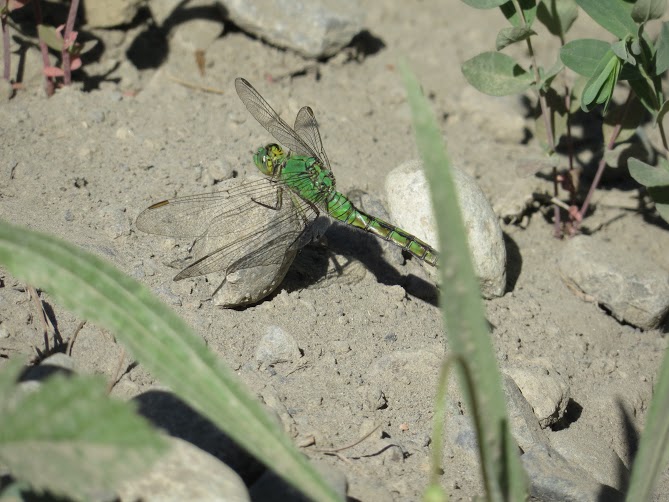 |
| One of several dragonflies we enjoyed and failed to identify - it really is starting to be a nice time to see them! Identification was obfuscated by the fact that "Green Dragonfly Washington State" brings up endless pages about the Green Darner, the official state insect... which is blue. |
 |
| Fields smelling like fresh-cut hay |
It was a day of eating poorly, to be sure, and I will admit that a stop at the Shell station near Sanderson Field led to the purchase of a corn dog. It smelled... so... good. From there, we headed off towards parts of the county that I had missed completely before.
Noonish
 |
| If nobody else names this, I'm calling it the Arcadia Peninsula |
I had a couple of hunches regarding the area between Hammersley Inlet and Skookum Inlet. It's technically a peninsula, with Totten Inlet running around part of it as well. The very end of it, Arcadia Point, peeks out into the fingers of South Puget Sound, and it has a creek running through the middle of it - Mill Creek - that at least on the map appeared to have some wetlands where we might continue our searches for Sora and American Bittern. I got the tingly feeling I get every time I'm driving new places.
 |
| Field - Binns Swiger Loop Road |
We took Arcadia for a little while before turning onto Binns Swiger Loop Road. I misread this on my map as Bunns Swinger Loop, which made our inner 12 year old boys laugh, and got us talking about Hurley Waldrip Road with similar results (the latter, we decided was perhaps a paint color inspired by a weak stomach at a fraternity party). We came across a nice marshy area with enough water for a mallard and some vocal Virginia Rails. Another tough bird became the topic of conversation - Cinnamon Teal! It's a code 2 bird, but... we don't know anyone who has birded the county who seems to know what the spots are or times of year for finding these birds, outside of going to Theler a lot and crossing fingers.
 |
| Marsh on Binns Swiger Road |
We rejoined Arcadia and then took a turn down a road that hinted of water views. We parked at a point that had a view of Mill Creek and got the attention of a woman who owned one of the properties. This was one of the highlights of the trip in some ways - she invited us to the back side of her house (I... may have dropped a hint about trying to get somewhere that would let us see the water, but I think she enjoyed the company as much as we enjoyed the invitation). Her house was sitting on a beautiful spot, with Mill Creek emptying into the salt water of Hammersley Inlet - the two bodies of water forming two sides of the triangular parcel.
 She was apologetic about the slightly wild yard, but we quickly moved on to discussing the trees, the birds (she gets Barred Owl, and we showed her some Pigeon Guillemots in the Inlet), the plants (roses and St. John's Wort came up), and shellfish (she gets money from a gentleman that seeds for several types of shellfish and harvests them from her little bit of shoreline - surely not the only such arrangement in the county!).
 |
| Mount Rainier from Arcadia Point - we left with only Pigeon Guillemot in the water. Squaxin Island straight ahead. |
2-4 on the Old Olympic Highway
Cara and I made our way back out to 101, and then to the Old Olympic Highway. This stretch of road runs parallel to 101 on the south side, and was a spot I wanted to investigate for California Quail. Yet another code 4 bird that we were hunting for, these little guys seem to have been largely pushed aside by Mountain Quail, but there have still been a couple of leads to follow. The county compiler for Mason County shared that this road was a place where he had found them in recent years, so I thought it would be worth a shot.
 |
| Find the garter snake! |
We started by investigating the Kennedy Creek Salmon Trail, but found some pretty foreboding signage. The coming of the fourth of July, and the dry season on the way have closed some areas to public entry. We wandered in a little, and were treated to a Pacific Northwest Garter Snake, but limited our exploration to the area within eye-shot of the parked car.
Heading up Old Olympic Highway, I was looking for two things: Quail habitat, or people. People know where there are quail. I've got this idea about owls as well. People won't notice a lot of the birds around them, but quail are active enough and look silly enough to get people's attention. We drove without seeing much of either quail or people before we found ourselves at the tractor dealership.
I walked out to the field where the two gentleman were trimming the grass and adjusting signage, greeting them with the explanation that seems to have been working when I approach complete strangers. 1) Clarify that I'm a birdwatcher 2) Mention that I'm doing a Mason County big year. 3) Explain that some birds have been hard to find but this is a good spot. 4) Ask if they've seen California Quail 5) Put my finger on my forehead and wiggle it around like the thing on a quail's head.
We had nobody at all imply that they had seen these birds anywhere down this road ever, but... but! The gals in the office thought that the trails up behind the dealership might be worth a look, "We could give you a golf cart..."
 |
| Easiest decision ever |
We found no quail on the way up or at the top, but what an interesting bit of help! Cara had been driving the whole day, so I had fun getting to take the cart up the hill. It's not the simplest of things to do a steep hill with a cart that has no reverse and sloooooow brake response, but the fresh air felt great. We got to the top and watched this clear cut for a little before giving up on this particular exploration.
 |
| Clearcut above the Old Olympic Highway |
Somewhere around 4 til 5:30 or so
 We actually left Mason County briefly *gasp* and ducked down to McCleary on Highway 108, then meandered our way over to Cloquallum Road to get back in to Mason. It was a new way to enter the county (I think I've come in from four others so far this year!) and it got me thinking that I should be collecting these signs.
 As we entered the county, we stopped at one of the earliest places we could. I looked down at the river below and saw a steep bank, "This would be a good place for a Bank Swallow", I mused, when a brown swallow flew overhead making... well the sound was a little different than the Northern Rough-winged Swallows I'd heard recently - not as monotonous and repetitive - although in the end, we decided that's exactly what it was. This decision was not taken lightly, however, and because the birds were backlit, we actually clambered down the river bank, and hopped onto the gravel bar at a narrow part so that we could get a good look-see.
The birds finally showed us that they lacked any collar across their chest, and we decided at that point that being down on the gravel bar carrying binoculars with a full view of someone's living room was a sketchy thing. Bank Swallows are a code 5 bird, and I honestly didn't even have them on my radar for the breeding season, although I love the idea of learning the calls better and keeping a close eye out for them in the fall. They often pass through in the fall without collars, I believe, which makes identification tricky, so the calls would be only one piece of it, but eyes and ears will be open!
 |
| Schafer State Park signage |
We made our way up Cloquallum and made a quite forgettable stop at Star Lake - I hadn't realized that it was just a resort lake that was developed right up to the edges. We peeked in between two houses to see an empty lake, and decided to move along! The forests between there and Schafer State Park were frighteningly dense. I had just finished a unit on fire ecology with my ninth graders, and the densely packed trees did not look like healthy forests at all. With the fire danger up this summer, I could picture an awful lot of trees going in one fell swoop.
 |
| Salal |
 Thing opened up once more at Schafer, and Cara and I took a little walk. I think we were certain that there was little to nothing new that we were expecting bird-wise, but it seemed important to spend some time at a state park in the far corner (or nearly the far corner) of the county. Taking a little half loop, we stumbled onto Salal, and lichen. Lots and lots of lichen. I had read that there were poachers of a sort, people who came into the Olympic National Park and drove off with lichen to sell to floral shops around the world. I'm not endorsing it, but it at least made sense after seeing and feeling the amazing lichens on the trees on this path.
We finally made our way out of the park around 5:30 and wondered... how can we get to the farthest Southwest corner of the county... right along the Satsop River?
5:30-6:30
"Can I help you?"
This was a sentence we had heard far more often than some goal-oriented neer-do-wells skulking around the hidden corners of the county with binoculars may have deserved. One more time, then, we were getting this question.
Cara and I were pulled over on the side of the road squinting at the map, when a woman asked what we needed. I explained that we were just trying to find a way down to the river, and I explained why (see above, minus the quail thing).
"Well... you can go up to the crest of the hill, and there is a trail that goes down to the river, or you could come up my driveway there and walk the river from my property."
!
So we accepted another gracious offer. and followed her directions behind their home, down to a dry creek bed which emptied into the Satsop. Very early on, we played for Bullock's Oriole, the species I dreamed would show up in this tiny little area. We were treated to a single cackle, and spent much of this time wondering if it was a Bullock's, or one of the handful of Brewer's Blackbirds that were using the fields and trees nearby. Nothing made us sure of the presence of orioles, so we continued down the streambed, which got more and more narrow as the bushes on either side impinged on our path.
 |
| Yay! |
 |
| Hold on a minute... |
 |
| Oh, never mind |
We actually spoke at length on a bird that she and her husband had seen regularly this summer, and only this summer. Pictures of Grosbeaks and Orioles all looked like they were on the right track, and the varied song she described could have been any of the above, but she didn't have enough information to make us sure it was or wasn't an oriole. (But, m'lady, if you are reading this, please use the message feature here and let me know if you've discovered more!). All of this tromping around on her property, and she tells us... "You're free to come and look again! It doesn't matter if we're here or not." Cara claims that the welcome we received all day had to do with her gender, and not necessarily with my charmingly disarming smile and pleasant unthreatening disposition. We may never know!
We need two things: Food and nighthawks (the rest of the evening)
We high-tailed it back to Shelton, where we found many places were closed or not serving food at 7 PM. Nonetheless, we came out of town with a growler full of beer from Grove Street Brewery, and a warm bag of MacDonald's "food". In town, we added a Western Scrub-Jay to the list for the 75th bird of the day.
 |
| Common Nighthawk - 161 |
Heading up towards Forest Road 23 again, we stopped in the first clear cut, and were treated to Common Nighthawks (161 for the year) nearly right away. "Peent!" they called out to us - three of them over this first field. I watched one dive and got puzzled by a noise. "You heard a vroom!" Cara told me excitedly. I watched and for 15-20 minutes this nighthawk repeatedly rose... rose... rose... then dove quickly, only to cup its wings at the last minute and swoop back up, producing a deliciously fake "Vrooooom" noise at the bottom. We ate our dinner, had a glass of Rye Ale from the growler, and enjoyed the show.
 Rejuvenated by vroom and ethanol, Cara decided we needed owls. We drove up past the High Steel Bridge, picking up at least a dozen more nighthawks on the way (including at least one calling from Lake West as expected), before stopping in a nice open area to call for owls. We pissed off every American Robin in the neighborhood, and got a call from a distant Barred Owl.
Figuring this was our last bird of the day, we made our way back to the Skokomish Valley when we got one more bird, and a new one for Cara for the year - a Barn Owl passing right in front of the car! We stopped to listen for it for a while before deciding it was just time to call it a day, and I think the car was telling me it was 10:30 when I closed my eyes, and much later when we landed at Cara's place. She may have explained how to use the water in their camper before my head hit the pillow, but I honestly can't remember.
 |
| Tough to see, but there is a Common Nighthawk in this lovely scene |
Subscribe to:
Posts (Atom)