Monday, March 30, 2015

March "Big Day" in The Mason

Technically...

...an official Big Day can only have one car, and the four members need to be in contact with each other at all times.  I found this out early in the day when I asked our trip leader, Matt Bartels, why no Big Days had been recorded for Mason county in March during the annual field trip.  So it wasn't a big day in that sense, but I was still keeping track of birds I had during the day!

http://www.potomacaudubon.org/Resources/Documents/Birdathon/bigdayrules.pdf  
The rules, for those curious!

Before the trip

The trip began at 7 AM in the Safeway parking lot, which gave me some time for owling before we met up.  An Orange-crowned Warbler (102) sang from behind the hotel on Saturday night to give me a start, and Sunday started with a Barred Owl (103 for the year, 1 for the day).  From here on out, I'll keep track of the year and day birds thusly (Year bird, day bird).  I tried my best to keep track of the day birds as we went, although I feel like I got a little lazy as others on the trip were tracking them.

This is not what it looked like.. at all.  I know that there
are ways to make your camera do things, but for now
I just don't have a picture of the morning.  It was breathtaking.
I stopped at Starbucks just at 5 AM, grabbing some breakfast and coffee.  They were happy to see some business at that early hour just as they opened, and we talked a little about birds as I ate.  Northern Pygmy-Owl was one owl that was supposed to be relatively easy in the county, and I had a lead from a field trip that had gone out the previous day.  Heading up the North Shore Road, I missed a turn and actually drove all the way to Tahuya before heading north to Tahuya-Blacksmith Road.  The view, however, was amazing, with thin clouds in parts of the sky, Sagittarius and Scorpius in the other.  Lights on the far side of Hood Canal were reflected in the water, and my camera skills failed me.  I'll work on drawing it or something... it was gorgeous.

Drew it from my notes a month later - this is what it looked like!  (But way less streaky)  4/28/15


Tahuya-Blacksmith Road is one of the roads that is often visited as people search for Mountain Quail, and the group had come across a Northern Pygmy-Owl which came into plain view.  I found the little gated side road pretty easily, walked in a hundred yards to an opening, and started calling for the owl as the stars started to fade.  It came in pretty quickly (104, 2), and kept calling away as I made my way back to the car.  Owls had been my biggest worry for the year, and I now had all of the annual ones except Spotted.

Back in Belfair

I made a little stop at Elfendahl Pass to try for other owls (unsuccessful) before heading back to Starbucks to meet up with the group for the field trip.  We had a nice full group of four cars, with birders from the Seattle area, Yakima, Naselle, and Gig Harbor.  I rode with Asta and Cara from Gig Harbor, and was happy not to have to drive. 

Getting ready to bird in The Mason
Matt provided us all with county checklists, and a map with the stops we would be making during the day, time permitting.  Some people's eyes went wide as they saw the stops were lettered through V, although of course, some stops would be unnecessary depending on the birds we found along the way.  In the parking lot, we listened to Dark-eyed Junco (3), American Robin (4), Varied Thrush (5), European Starling (6), and watched the Rock Pigeons (7) hunting the parking lot for crumbs.

Elfendahl Pass Road

Mountain Quail habitat
Once we were all gathered and had made introductions, we piled into cars and headed up to Elfendahl Pass Road, in hopes of finding Mountain Quail.  We were greeted by more robins and thrush, and other birds joined the morning chorus as we got onto the trail:  Pacific Wren (8), Bewick's Wren (9), Spotted Towhee (10), White-crowned Sparrow (11), and some Purple Finches (12).  The finch songs were so lovely - and they added their little vireo like calls to their songs the whole time.  I have to say Purple Finches are one of the birds I've learned the most about vocally this year.


Scot's Broom - a required planting for attracting Mountain Quail?
We made several stops, eventually coming to a full halt on the noisy gravel we were walking.  The only sounds we had were the birds around us and the numerous mosquitos!  Finally we got a response... a soft clucking that I heard twice from the Scot's Broom that had filled in the decimated areas of the landscape. 

Now... I struggled with this one.  I do count heard-only birds, but... we never got the distinctive piercing calls that these little dudes make.  "That was Mountain Quail."  Matt told us, just as information, but not as an encouragement to count them.  Matt respects the rights of others to keep their own lists, and to make decisions about what birds to count/not count.  That said, he has for himself kept a list that is free of heard-only birds.  Through patience and persistence and skill, he has nonetheless built county lists over 175 in every county in the state! 
Evidence... Mountain Quail footprints
I knew that there were Mountain Quail there.   It was the right habitat.  We even at one point found footprints in the mud.  The pictures I got of the tracks matched MOQU, and not Ruffed Grouse (the only other clucker that I could imagine up there).   But... was this distinctive enough??  Here's how my decision went:   1) I stand by my choice to county heard-only birds.   2)  I know that I heard a bird, and I'd bet quite a few dollars that the bird we heard was a Mountain Quail.  3)  Still...  4) I have a sense of humor which must trump all in "difficult" situations. 

So here we go.  I'm counting it.  Mountain Quail (104.5, 12.5). 

I realize that I may lose some of my massive readership every time I need to leave this as a 0.5, but it's the obvious choice, given facts 1-4 above.  Nobody will be more annoyed and distracted by it than me, so I'll get back out there to look for those elusive little dudes.  Until then, I will enjoy the fact that I was able to count this bird while still finding a way to keep less forgiving list-keepers off of my back.  I'm sure the ABA will have me round down in the end, and I'm happy to do so if I must, come December.

American Robin on an overcast morning
Red-breasted Nuthatch (13.5), Tree Swallows (14.5), Mourning Doves (15.5) and Yellow-rumped Warbler (105.5, 16.5) rounded out our morning in the perhaps-unsavory habitat that Mountain Quail call home, and we headed off to Belfair State Park.

Belfair State Park

This was a productive stop for the group, and I picked up a couple of year birds.  We of course passed through the wooded area between parking and the water.  Today it held Pine Siskins (17.5), Song Sparrow (18.5), Golden-crowned Kinglet (19.5), Steller's Jay (20.5) and later on, a Bald Eagle (21.5).

The water was very productive, and I apologize for not getting a lot of bird pictures.   I think most importantly, the Marbled Godwit (22.5) was sitting so close, a good picture would have been easy to do, but I got too caught up in the birding and with the rest of the group!  A few easy birds were found and heard quickly - Mallard (23.5), Bufflehead (24.5) and Killdeer (25.5).  Getting closer, we quickly found some more birds, including a half dozen Greater Yellowlegs (106.5, 26.5). 

A couple of Bonaparte's Gulls - Belfair State Park.
I did miss birds that others had here, including Dunlin and Herring Gull, but the excitement came when one of the scopes landed on an Eared Grebe (107.5, 27.5).  The awesome thing about heading out at this time of year is that the little grebes give some more clues to help in their identification.  The Eared with the black throat was observed for a bit before we got scopes trained on a Horned Grebe (28.5), which was starting to show some red in the throat.  Did I apologize for not having pictures?  I'll apologize again, but to be fair, this bird was not all that big even in the scope, sitting more that half way across the water to the other side.

Other water birds seen during this stop included:  Canada Goose (29.5), Common Goldeneye (30.5), Northern Pintail (30.5), Green-winged Teal (31.5), Greater Scaup (32.5), Common Merganser (33.5), Red-breasted Merganser (34.5), Surf Scoter (35.5), White-winged Scoter (36.5), Double-crested Cormorant (37.5) and Belted Kingfisher (38.5).  Gulls also included Mew (39.5), Glaucous-winged (40.5), and a new one for the year - Bonaparte's (108.5, 41.5).

American Crows  (42.5) were seen at several stops, starting at the Safeway parking lot in the morning.  I'm not going back through to change all of the numbers, hopefully you're with me on this one.

Mary Theler Wetlands
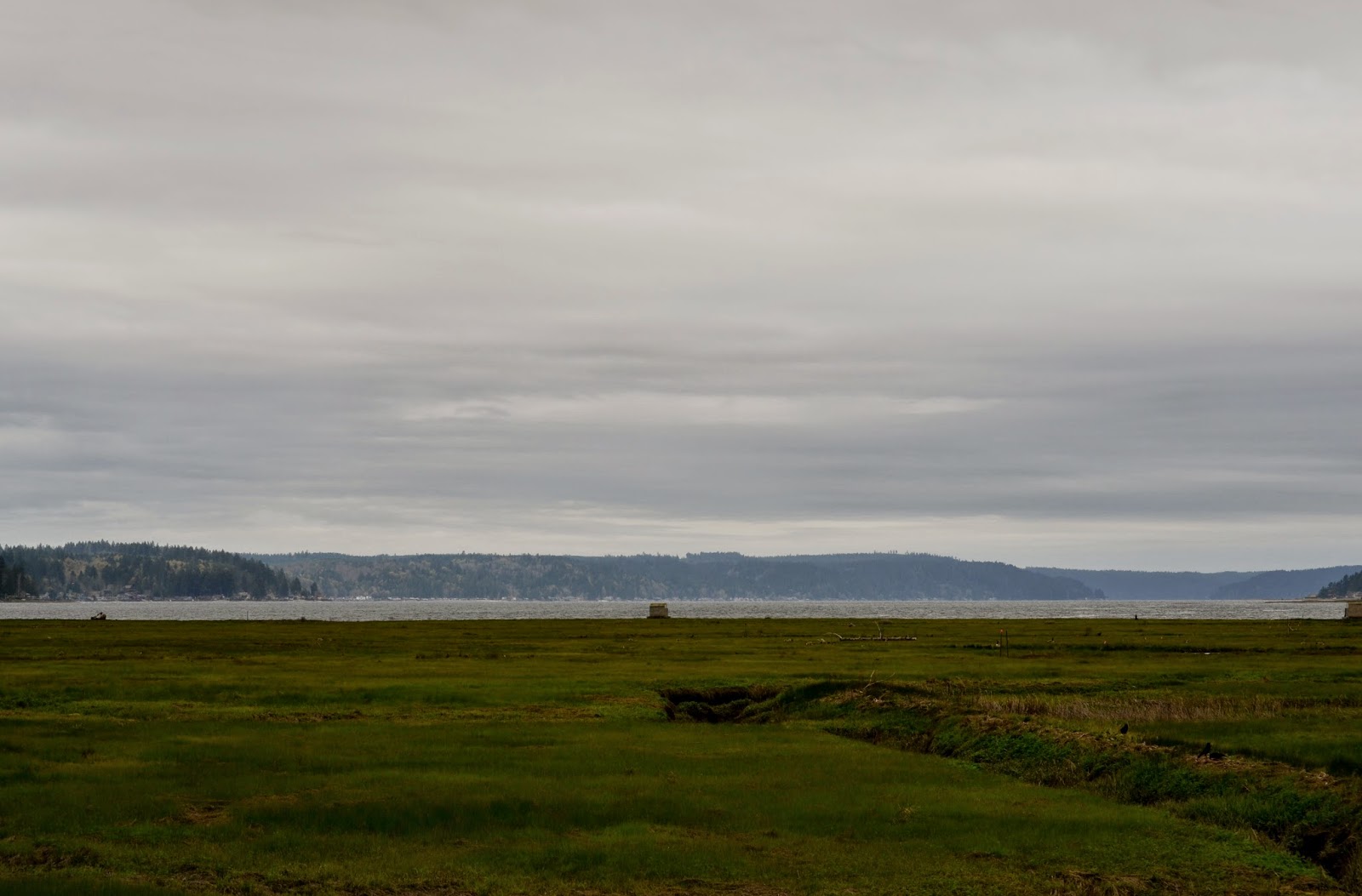

You can't make a trip to Mason County without stopping at Theler!  Well... I do hope to challenge that assertion at least once this year, but it is a pretty productive place, and quite a few of the year birds that had been waiting for warm weather were waiting for me there. 

Flowering Currant - this one pulled in a Rufous Hummingbird
We got our House Sparrows (43.5) as we walked in, and tried for Barred Owl, finding Red-breasted Sapsucker (44.5) instead.  As we came out to the opening with the education center and plant exhibits, we marveled at all of the flowering currant.  "There ought to be a Rufous Hummingbird here!" someone thought out loud.  Ask and ye shall receive!  The hummer (109.5, 45.5), made it's rattling hum for us, and proceeded to do several J dives, lifting high above us slowly before plummeting down near our heads and swooping back up at the very end. 

Rufous Hummingbird - Mary Theler Wetlands
Onto the boardwalk through the woods, and we came across what some including myself briefly thought was a Hairy Woodpecker, but it showed itself to have a tiny bill and a soft call, so we went with Downy Woodpecker (46.5).   A puzzle for me was solved as we came around the corner to what used to be a rail marsh - they've moved!   In the salty remains of their previous habitat, we had numerous Song Sparrows, Red-winged Blackbirds (47.5), and Marsh Wrens (48.5) chattering away.  I got a double dose of new birds as a Common Yellowthroat (110.5, 49.5) sang a few times (this one went unseen for us, by and large), and a Turkey Vulture (111.5, 50.5) flew overhead. 


Savannah Sparrow
As we continued around the corner, spring continued to greet us in the form of Tree (51.5) and Violet-green Swallows (112.5, 52.5).  Others heard and saw Northern Rough-winged in the mix, but I never got on one of them.  It was still nice to discuss the different flight patterns of swallows, and some described the roughies as having a more bat-like flight.  I'll have to look for that down the road.  Savannah Sparrows (113.5, 53.5) sang from the fields, and eventually came in to view for photos.

Find the Virginia Rail! 
We came to the new home for the Virginia Rails and got some glimpses of some as they scurried around their little reedy puddle (114.5, 54.5).  It was nice to see them, and to finally have this bird in the bag.  It's interesting how easy they are... if you know where to look!.  I'll have to come back to this spot for Sora later in the year. 

Level two - find the Virginia Rail!

We had no Red-tailed Hawks here, but we doubled up on Falcons with an American Kestrel (55.5) in a tree, and a Peregrine Falcon (56.5) soaring high above us.  Again, I benefitted from the presence of knowledgeable birders, who could discuss the pointed wings in addition to other field marks on the bird.  I learn a lot every time I get out on field trips.

Canada Geese coming back to ground - Mary Theler Wetlands
We circled past the Salmon Center and the llama pasture hoping for Ring-necked Pheasant, but were skunked again!  Nearly everyone in the group had Wilson's Snipe, either in that field or elsewhere during the day - they were a miss for me.  We also passed a field which should e good for shorebirds down the road.  We all saw a Great Blue Heron (57.5), and a few people saw what may have been dowitchers dipping out of sight.   This one was hard to walk away from!  I confirmed that Long-billed are the more difficult dowitcher in the county.  It would have been nice to see some at a time when Short-billed would not even be in the state! 

White-crowned Sparrow (Pugetensis)
Rounding the corner past the vault toilets, we came across some White-crowned Sparrows, and Bushtits (58.5).  We got songs from Ruby crowned Kinglets (59.5), and Orange-crowned Warblers as well (60.5).  Whoops!  Northern Flicker  (61.5) should have been on the list several times over by now!


One of my favorite shots in Theler - I'll try to get it monthly.
More signs of spring - there's a Marsh Wren nest at center.
(We also saw Song Sparrows copulating, but I'll keep
the blog PG-13...)


Twanoh State Park


I was aided by so many good sets of eyes on this trip.
Our next stop was Twanoh - and we found some good day birds from the parking lot:  Common Loon (62.5), Western Grebe (63.5), Red-necked Grebe (64.5), and Barrow's Goldeneye (65.5).  Both chickadees made appearances (66.5, 67.5) as we made our way over across the bridge to get a view from the other end of the park. 

I was still missing Pacific Loon and Black Scoter for the year, so I had my fingers crossed that this time there would finally be at least one of them at Twanoh!   Yes and yes!   Three Black Scoters (115.5, 68.5) were mixed into the Surf Scoter flock, and Matt and Alan got onto a loon that we nailed down as a Pacific (116.5, 69.5) - more delicate bill, and a nice straight light/dark line down the neck, unlike the broken pattern on the Common Loons.   

We also found a Pigeon Guillemot (70.5), and the loon sightings above remind me that I had a brief glimpse of a Red-throated (71.5) back at Belfair. 
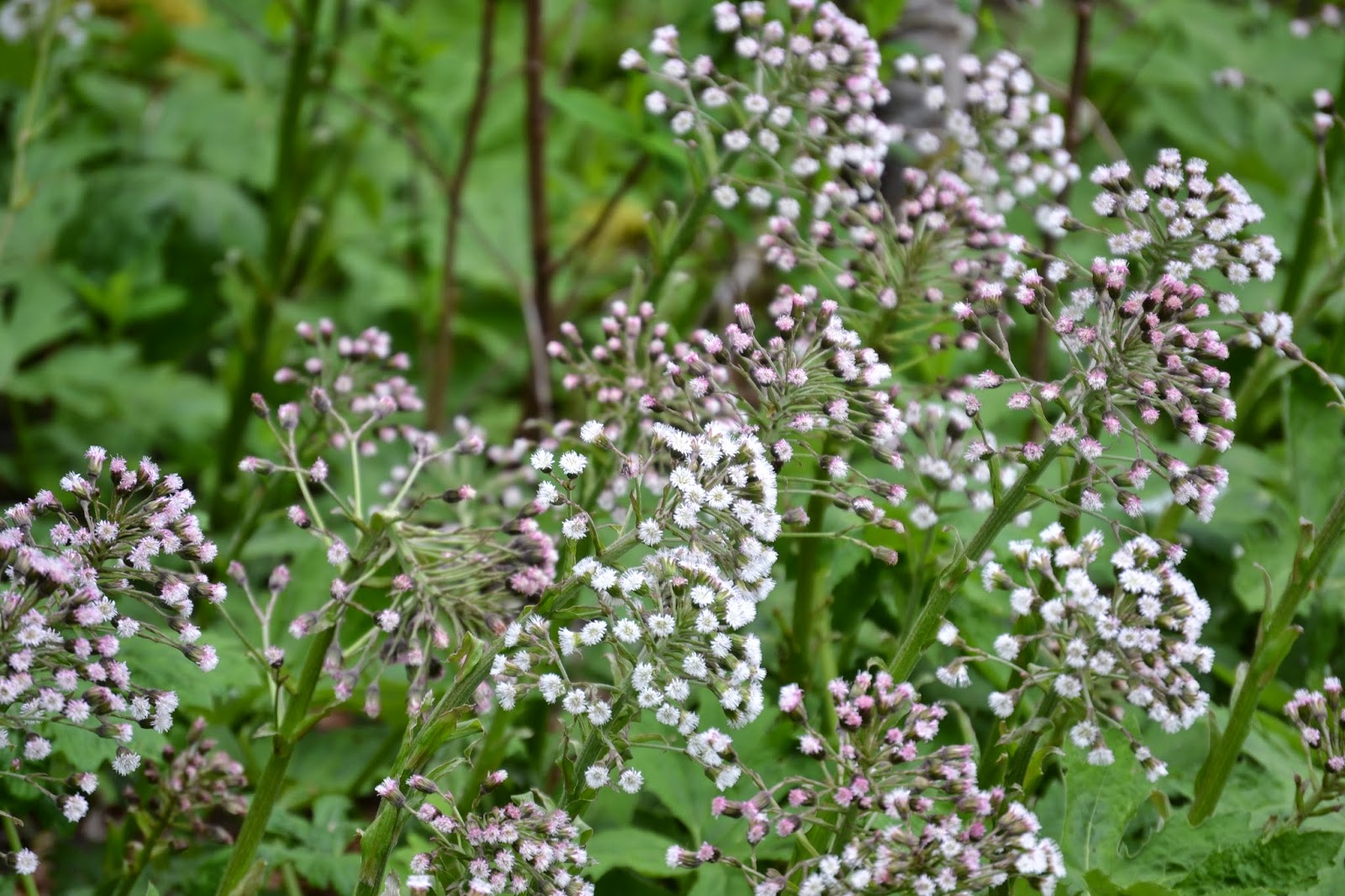
Coltsfoot - Twanoh State Park
Leaving Twanoh, I now had the three birds that had most worried me (Black Scoter, Pacific Loon, and Eared Grebe) found for the year.  I'd had my fingers crossed that a lot of knowledgeable birders with scopes at this time of year would do the trick, and it was comforting to think that I could spend some time away from the saltwater to focus on some other birds (not the least of which was the ugly 0.5 bird making my list so untidy!)


Skokomish Mouth, Hunter Farms, Purdy Creek, George Adams Hatchery

None of these were full-blown stops, but we added a few more birds:  Red-tailed Hawk (72.5), Greater White-fronted and Snow Goose (73.5, 74.5) still in the flocks at Hunter Farms, and three new birds at Purdy Creek - Ring-necked Duck, Pied-billed Grebe and Lesser Scaup (75.5, 76.5, 77.5), and an American Dipper at the Hatchery (78.5).  This was just seen out of the corner of my eye, but it flew in under the bridge, ostensibly to a nest under there! 

Potlatch? Potlunch? Potluck?
Potlatch State Park


We made another stop for Mountain Quail - this one was closer to Highway 101, so it may fit well into my April trip.  I've struck out so hard on game birds, it seems like I'll need to take a morning just to go after like... all of them!  I'll lay out those plans later, but it all has my mind spinning with plans. 


More Mountain Quail habitat
At Potlatch State park, we found American Wigeon (78.5), and had better looks at White-winged Scoter.  This was just a beautiful stop, and some good lazy time after a lot of quick stops.  We also went up the road a little to a park that let us peek at some Harlequin Ducks (79.5) I kept missing the turnoff for this, but had found Harlequin once nonetheless from Potlatch.  More breeding plumaged grebes were hanging around as well - I wonder how much longer they'll stay?

Skokomish Valley Road

We had a lot of birds here that were missed or almost missed!  First almost all of the cars drove past a Merlin (117.5, 80.5) with the trailing car picking it out.  A three falcon day is a good day in Mason!

Merlin - Skokomish River Valley
Almost as good was making it a four dove day.  I missed the Band-tailed Pigeons (which I needed!  grr...), but others found them, and the rest of us found Eurasian Collared-Doves (81.5).  In the blackbird flocks we also had Brewer's Blackbird (82.5) and Common Ravens were overhead (83.5).  I was surprised here and everywhere that Golden-crowned Sparrows had made an exit, or at least were far less prominent.  Lincoln's Sparrow is another one that we missed today, and I'll hope will be there in April when they have a big migratory push.

And it may have been a Lincoln's Sparrow I was looking for behind the Skokomish Grange when someone yelled "Northern Harrier!"  I was a bit back from the road.  I figured I could go binoculars up, or run up to the group.  I went binoculars up and listened to directions.  Nothing.  I got closer and listened to more directions... nothing.  I couldn't get on the bird and it eventually went out of sight.  Cara and Asta were sweet enough to take the car back down the road, but we were unable to recover it.

Up the road a little more, we passed some Wood Ducks (84.5) in the pond (flooded area?  what's the distinction?) north of the road.  With that, we made the turn for my fourth?  fifth?  trip to...

Eells Spring Hatchery

The target here was Green Heron, and Dave was there as usual.  "How much did I miss him by?"  I asked after a wave.  "He was here yesterday."  After this many trips to the hatchery, the regular worker there knew that I was looking for the Green Heron.  We tried the back ponds and searched the trees before consoling ourselves with our first good views of a Steller's Jay, and our first good listen to a Pileated Woodpecker (85.5).

As we piled into the cars again to leave, someone called - "Green Heron!"   We all piled back out and found it.  Obscured way back in the branches, the little dude finally showed itself (ish) for the year.  (118.5, 86.5).  I struggled trying to get my camera to focus.  I will admit now (and those who know how to use cameras well have already suspected this).  I'm kind of a hack with my camera.  I mentioned not being able to get the Green Heron in focus with all of the obscuring branches in the way, and Asta graciously showed me how to manually focus my camera. 

LOL

Anna's Hummer?  This was a seen-only bird, sadly.
So I know how to do that now!  I still got no successful picture, but it was a success of sorts, and I'm sure I'll put it to use in the future when my camera can't figure out what I'm looking at.  The feeders at the hatchery were productive again, giving us Anna's (87.5) and Rufous.    I snapped the picture of the Anna's, and admittedly I often rely on sound for distinguishing hummingbirds if we're talking about females in the summer when both Anna's and Rufous are present.  I showed someone the picture to discuss the ID, and was told "Sorry... we're busy looking at the actual birds."

Photography is a funny thing.  I've seen it nearly ruin people's enjoyment of birding.  At its worst:

* It becomes a drag as people wait for the guy who has to get the perfect shot.
* It becomes awkward as the person unable to get the perfect shot becomes irritable.
* It turns into a little trophy case of sorts.  "Hey... wanna see my shot of the Brambling...?" with all of the requisite pats on the back.
* Photographers at their worst disturb the birds and indirectly the people who are trying to see them by flushing them (and yes... that was me with the Merlin on this field trip.  Ugh)

So, I get it.  I know that as soon as the binoculars are replaced by a camera, there's the potential for bringing the worst of photography into it.  I hope that the poor quality of the pictures to which I continue to subject my readership will assure them that I haven't gone off the deep end as far as all of that goes.  I do hope to capture some beautiful places, some beautiful birds when it works out, and of course in many cases, I hope to get shots of birds that might be difficult to identify or document without a picture. 
Rufous Hummingbird - Near Eells Spring Hatchery

The owners of the feeder gave us a happy hello as we had the cameras and binoculars trained on her window - proud to have others enjoying the hummingbirds as much as she was.  Then we piled in one more time and went up my favorite kind of road.

Primitive Road;  No Warning Signs

Now, that sign in and of itself is a warning sign, although I get what they are trying to say.  I think it would be awesome to find a road like that that didn't even warn us that there wouldn't be any signs.  That would be primitivity at its best!

"Cara, could you stop driving over the rocks?  Please... it's shaking the binoculars.  Thanks." 

As we were heading up Eells Spring Road, heading up the hill and over to Dayton, we were far enough into the day to joke around.  As we ascended, Matt let us know on the radio that this was good Hermit Warbler habitat, and I made a mental note to come back in May!  Our target bird here, Western Bluebird, had been 732 percent guaranteed by Matt, and a pair of them came in to one of the giant rubbish heaps to help him keep the guarantee (119.5, 88.5).
Western Bluebirds - Eells Spring Road

It looks like there is clearing going on to put in more houses in the area.  We finally hit pavement, and headed down past a velodrome (interesting thing to find here!) before we got to the road that heads out towards Matlock.  We had originally planned a trip out to Matlock and Nahwatzel, but we had our bluebirds, and I think Lake Nahwatzel has not been handing out coots lately, so we simply continued down to Little Egypt Road. 

Little Egypt Road was a place where I had hoped to find rails, but had clearly not driven far enough.  We came to a wet wet meadow and got some.  Matt played for Sora as well, which is something that I will be sure to do here this year, given the habitat.  We did get Virginia Rails to respond, but not much else was going on in the drizzle, so we pressed on to Shelton.

Shelton

The Mountainview neighborhood of Shelton is a place I had visited twice this year - it's easy enough to stop in and do a quick search for Western Scrub-Jay.  I realize that I looked a little odd walking the neighborhood with binoculars, but now fifteen of us coming through were enough for people to really gawk!  People were pretty pleasant with it, at any rate, and told us to enjoy our day once they figured out we were birdwatchers.  The neighborhood came through and gave us our scrub-jay (89.5), and House Finch (90.5).

From there, we made our way south to the final stop of the day - Kennedy Creek.

Kennedy Creek Estuary

I have to go back and look at the tide tables, but it was clearly well below a ten when we got there around 5 o'clock.  The birds were much farther out than on my previous trip, but we did find the huge flock which included Dunlin (91.5) and Black-bellied Plover (92.5).  The gulls and ducks added nothing to the day list, although we did end up finally getting a listen and a look at a Brown Creeper (93.5).  I have had Northern Shoveler here before, and this is a place I'm sure I'll check again in an effort to add those to the year list.  For a code one bird, they're pretty tough!  I mean, they're no American Coot, but...

Heading home  

Cara and Asta took me back to Belfair, and it was lovely to have the binoculars down and the brain off of birds for a little bit.  We made a stop or two for coots as we returned to Shelton and back up Highway 3, but mostly just talked about the other things we love about Mason County.  They passed on gas money for the day, negotiating instead for a return trip and payment in oysters and beer. 

My kind of people.

I'll update the needs list and running tally soon, although I don't know that ebird is going to accept a 0.5.  Details... details.   I'll also be laying out a plan for April, which is hugely affected by the birds I found (water birds and owls) and didn't find (game birds).   If I can make a trip in late April, there may even be some good shorebirds to hunt down!

Happy birding!

-Tim
Just to hint at the level of planning that goes into seeing
nearly a hundred species in Mason County in March!
Map by Matt Bartels of the Washington Ornithological
Society

Mason County March WOS Field Trip - The trip over

It felt like Lent

Tree Swallow - finally spring and finally back to Mason County!


After a month and a half of waiting, I finally got the chance to get back to Mason on Sunday.  It was a shortened trip, as March was full of busy weekends, and this particular one involved time at the food bank and a volleyball game before I left on Saturday.  This was a special trip, as I was joining an actual factual field trip! 

Mountain Quail from an
online search.  I didn't quite
get this look!  :D
Matt Bartels runs an annual field trip to Mason County for the Washington Ornithological Society, and this year it fell on the late date of March 29th.  Why March?  March is the month when Mountain Quail begin to vocalize quite a bit more, and they are a specialty species for Mason County;  Other neighboring counties (and a few in the southeast corner of the state) have sightings of these birds, but there are a lot of spots to make attempts at seeing them in Mason, and early spring is not a bad time at all to be birding along Hood Canal in Mason County.


Passing through

My normal route over to Mason takes me through Pierce and Kitsap Counties.  I actually ventured over to Pierce a month or so back and added a few more birds there to bump it up to 150 for my life list.  Kitsap has been sitting at 114, so I decided to pick away at it a little bit on Saturday.  After chatting with Brad Waggoner over in Kitsap about my needs list, it came out that the south end of Kitsap looked like it would be more productive, given my needs list.  

"Four hours or so in the great county of Kitsap to head to the birdless Mason County ;-)"  Brad's slander of the fair county was tongue-in-cheek, but there are a fair number of birds that are a little easier in Kitsap.  They do seem to have some of the same issues with some "simple" birds like American Coot, but there's a good bit more saltwater shoreline, and Point No Point seems to pull in vagrants now and then. 

Sadly, the side trips on the way over didn't add much.  A trip to Long Lake (and parking near a mailbox to look nearly directly over someone's house...) got me a Wood Duck for the County, but no American Coots.   A trip to Lider Road, in the Blackjack Creek watershed, gave me Brewer's Blackbird, but no American Kestrel.  Another stop at Gorst finally gave me a Northern Pintail, but the trip up the road West from there, following Gorst Creek, left me without an American Dipper.  Kitsap County was distinctly un-American for me on Saturday!   Some year, I'll hit Kitsap County properly, but around 5 PM, I decided to hang it up and continue to Mason.


Saturday evening - Belfair-ish

I came in along NE Old Belfair Highway, entering Mason County from a direction I hadn't previously this year, although I recognized the Bear Creek gas station and mini mart as I passed.  It was a pretty drive, and I had a couple chances to step out to look at Union Creek in hopes of a Dipper, or even a coot in some of the wider areas.  Pacific Wrens were the rule, however, and I finally came out in Belfair. 

Another way in - Old Belfair Highway NE
I checked in at the Belfair Hotel this time, since the field trip would be leaving from there the next day.  The gal at the desk started to tell me about their amenities, then laughed, "We.. don't have anything special.  We have an ice machine!"   She added the last bit excitedly as she remembered.  I didn't need anything special, and it was a clean comfortable room, so all was well. 

The brochure in the room had a few local eateries featured, and I decided I might head down the road to Allyn on Case Inlet to Lenny K's Boat House for some fish and chips.  I had considered a few of the places in Belfair, and was only disappointed when I found out that more than one of them has karaoke on Saturday nights.  Oh I will be back.


Allyn

Allyn sits on the north end of Case Inlet, a tiny finger of Puget Sound that nearly stretches out to meet Hood Canal (if it had ever actually done that, we would speak of Kitsap ISLAND rather than the Kitsap Peninsula, but it landed a few miles short).  I had driven through it once or twice during the year - once when it was dark, and once while in conversation with a copilot. 

Case Inlet from Allyn
I pulled in to Lenny K's parking lot, and took a quick walk down to the water - Shaggy-headed Red-breasted Mergansers, a few crows and gulls played on and near the shore, but nothing surprising.  I crossed the street to the wine shop just as the fellow was closing up.  He was kind enough to let me in, although I was too late to do any tasting.  The most interesting discovery was Mosquito Fleet Winery.  There was only one bottle left on the shelf, but their tasting room is on the very road I had taken into Belfair - another reason to come back!

"The Flyer"  - 90 minutes from Seattle to Tacoma. 
Original artist unknown - I pulled this from Geocaching.com
The Mosquito Fleet, incidentally, was the nickname for all of the little steamboats and other small boats that served Puget Sound before ferries became the norm.  Some of the later runs went from Allyn to Olympia with stops on some of the Islands (Squaxin and Harstene) along the way.  I still have hopes of doing part of this run by boat this year - stay tuned!

It was that good.


Lenny K's was a great choice for dinner - the fish and chips were great, the service was friendly, and there was live music playing (Marcus Dean on that particular evening).  There was a whole array of mugs hanging above the bar, and I nearly joined the mug club, but it sounds like most of the benefits come on Tuesday nights.   My plans aren't that ambitious for my year with Mason County!

I made it back to the hotel and off to bed with dreams of owls and another big day of birds.


Thursday, March 5, 2015

Watching and waiting

I knew I was doing this year on a budget.  The budget is primarily time related.  I am planning monthly trips over to Mason, and in this case the February trip and March trip are over a month away from each other!  In late March, there is a field trip running to Mason County through the Washington Ornithological Society, and I plan on attending.   That would be a single day trip, and I think I will try to come over Saturday after my son's volleyball game finishes up in Seattle. 

If I was inclined to chase... there have been a few tempting birds coming through, but so far, it hasn't been enough to get me to drop what I'm doing with work, family and friends at home.  Still, I want the blog to be as useful as possible - not just for the year I had, but for understanding birds that come through, so here goes:

What I've been missing (in taxonomical order):

1)  Cackling Goose   A flock of these came through Theler around the time of my last trip in late February.  I missed them and I don't think more have come through.  Bar charts tell me these will be back in the fall in bigger numbers.  Fingers crossed for this Code 3 bird, but I'm glad I have four other species of geese in the bag.

2)  Tundra Swan   Two were seen by the Denny's in mid-January.  I had suspicions about some swans that I had pictures of, but the consensus has not pointed towards Tundra for any of them.  I'm not expecting these to come back through, as they are a Code 5 bird.

3)  Northern Shoveler   These were not recorded in the county until the first of March - 8 near Alderbrook.  This is one of those birds in the county that just seems tougher than it should be!  I have had them before at Kennedy Creek, and continuing to check estuaries should pull some up so I didn't need to chase this sighting.

4)  Black Scoter  There have been actually an embarrassing number of sightings of these, and I hope they are around for the March trip so I don't have to sweat it in the fall.   Again... how many surf scoters do I have to look at??  How many??  This bird is not one to chase - it's one to find with patience and persistence.

5) Ruddy Duck  A code three bird seen at Theler in February, with some other sporadic sightings in December from Mason Lake and Skookum Inlet.   I haven't birded at either of the last two locations, and I think that needs to get resolved soon.  They won't be part of the March field trip, so perhaps a quick visit there will be in order.  I know the Biser's want to see this one, as Ruddy Duck is Beth's favorite bird - hopefully one will hang around somewhere for us soon, but no sightings have been repeated anywhere.  Not a chase bird.

6)  Ring-necked Pheasant  Sitting at Theler every day and I keep missing it.  I have two other leads on places to find these in the county.

7)  Ruffed Grouse  These are a yard bird for the Biser's and I am hopeful that by the end of May I will have seen one or at least heard them drumming.

8)  Sooty Grouse  Someone made a trip up to the Mount Ellinor Trail and found some Sooties!  This was a fun sighting to see - no rush on them, although getting them earlier will be better than later.  I have unfinished business down low before I start looking for high-elevation birds.

9)  Mountain Quail   Matt Bartels had some calling on Elfendahl Pass while scouting for the trip.  They shouldn't be a hard bird on the day of the field trip.  Seeing them can be tough.

10)  Pacific Loon  See Black Scoter

11)  Eared Grebe  See Pacific Loon  (These three birds... I gotta get 'em.   The March field trip should give me chances to see all three, although I'd be surprised if we got all of them.)

12)  Green Heron  No eBird sightings, but Dave at the Trout Hatchery has them every... single.. day... As many as two of them.   Eventually, I'll just be there from sunrise to sundown if I have to!  Or fill out an application for work at the hatchery.  I'll get it.  Up to three attempts now, and another attempt will be added in March on the field trip.

13)  Turkey Vulture  They're back!  Yay!  No need to chase.  They'll be around

14)  Northern Harrier  Code one bird - yeesh.  There have been sightings at Twanoh and at the mouth of the Skokomish.  I had a phantom bird that could have been one at the mouth of the Skoke, but I should find one... right?  I should?   It will be a relief when I do.

15)  Virginia Rail  Yeah, they show up on every trip report from Theler.  I have had them at Theler.  I've tried for them this year in the exact same place but am oh for three now.  March... March... It's not like they're going anywhere.

16)  American Coot  I included this ridiculous bird just out of principle.  Nobody has seen any of them but they are a code 1 bird in the county, so there are some of them somewhere.  Probably... maybe.  I don't know.  Where are they?

17)  Greater Yellowlegs  Easy bird once spring rolls in, but there was a sighting from the Skokomish Valley.

18)  Least Sandpiper  From Theler.  No big deal - there will be more.

19)  Sanderling   Now... hold on!   This showed up on ebird, but has not shown up on the Mason year list on eBird.  I almost chased that sighting, but simply couldn't.  This is a Code 4 bird, and it would be great to know what happened to the original report from Theler.

20)  California Gull  Some are hanging around.  There should be more in summer.

21)  Band-tailed Pigeon  They were in the county during my last visit, but they are IN the county now.

22)  Spotted Owl  Well... I'm checking on this.  I hope I can bring one of these to the blog this year, just to let people know they're still here.  Apologies if I don't give out GPS coordinates to the nest site, but there's rules out there for these guys.

23)  Northern Pygmy-Owl  Elfendahl Pass Road in the wee hours a week ago.  Very cool to see them added in on eBird, and it gives me another place to look for this owl.  No shortage.

24)  Barred Owl  I'm up to like... eleven leads on Barred Owl.  No chasing needed.

25)  Gray Jay  Up top - no problem.  I'll get there.  They were seen on the Mount Ellinor Trail.

26)  Barn Swallow  Ten are already here.  Ten million will follow.

27)  Orange-crowned Warbler  One sighting from Theler.  I am hopeful some will be singing on the March trip.

28)  Lincoln's Sparrow   April may give me better chances, but I may find myself scouring every sparrow patch in the county next fall!

29)  Western Meadowlark  Dang it.  Seen and photographed at Theler a week or two ago and not since.  This was one of those birds where I wasn't sure where it might show up.  Theler may be the answer for a lot of birds like that.  It's pretty good habitat!

So... I guess I have to apologize for not having a total of 130 at this point!  or... somewhere around there.   This is at least a summary of what might be on my list if birding Mason County was the only thing taking up my time!  

Hang in there, faithful readers!

-Tim

Wednesday, February 18, 2015

2/16 Small Day

Still Waters Farm

After a fairly productive day on Saturday, and a very hard sleep, I did something that I may just continue to do.  I slept in and prepared to take a more leisurely pace on Monday - not driving to as many places and trying to rack up a lot of species, but to explore a little more and spend some longer bits of time on fewer species.  I got up with it still dark, and tried a few times for Barred Owls, which the Biser's have had on their property recently.  A warm shower and a change of clothes later, and I walked the driveways running along the lake and the rest of the property. 

The ducks still hadn't made their way out onto the water, but other birds were starting to sing, including both chickadees, Song Sparrow, Pacific Wren and Brown Creeper.  It's been interesting to hear the birds just start to warm up their vocal cords.  The fog rose from the pond at the center of the property as I looked along its edge for Ruffed Grouse.  Mark has run into one of them fairly regularly in the same areas on his property.  None showed up today, but there are many months to come!  All of the game birds ought to be more vocal (or.. well you know... many of their noises don't come from their vocal chords!) as spring moves along, which should get me out of the rut I'm in with them - not a single one yet!

Shelton

Mason County traffic
I gave up on owls and game birds once things got a little light, and made my way in to Shelton for breakfast.  Blondie's at the Shelton Inn has been my people-watching spot.  It was pretty busy as I had the special (Polish link!), and I got to listen to an interesting conversation between five guys about Cabella's.  The topic turned quickly to the difficulties presented by the traffic circle leading to the entrance.  I laughed at the time, as I navigate one every day in getting to work, but I realized... they are kind of annoying things sometimes!   It got me thinking about traffic in general, and how numb we really have gotten to all of it.  My brother sometimes visits Renton from Yakima, and nearly goes crazy with the traffic.  In retrospect, I was a little envious of a life that was as traffic free as the one they likely had.

Cloquallum Road

Hairy Woodpecker - 100!
I had a short list of birds I was looking for as I left Shelton and headed east.  I wanted to check some of the lakes for American Coot, some of the clear cuts for Western Bluebird, and some of the farm land for Northern Harrier.  I had even thought that Schafer State Park would be on my itinerary, just to check it out and possibly pick up some of the woodpeckers I was missing.  Two of them showed up for me at a clear cut, however!  I heard a Red-breasted Sapsucker (99) hammering away, and followed the sound to a pair of them on a snag, then a Hairy Woodpecker (100) announced its presence a mere five trees away!

The Hairy Woodpecker may have been my 101st bird of the year if I counted the Greater White-fronted Geese that I unknowingly took pictures of the previous day, but I was celebrating it as the hundredth bird, so I'll leave it there.

Nahwatzel Lake and Matlock
Mason County... you've got to be cooting me...


I turned north on Highland Road to cut up towards Nahwatzel Lake, with Evening Grosbeak and Hutton's Vireo joining the list of birds that I found today but not the day before.  The Hutton's was emphatically giving its own rendition of "zuwee", but not one that was familiar to me.  I smiled when it finally changed its tune to something more familiar, filing away the new call in my head. 

I wanted to take a look at Panhandle Lake, but the 4H camp there advertised itself quite clearly as private, and the gate was pretty foreboding.  I sat at the entrance for a few minutes, just listening for sounds from the mixed habitat of clear cuts and copses.  Nothing but Common Ravens and a light breeze. 

I finally made it up to Nahwatzel, and tried several pulloffs before finding the boat ramp.  The lake had a cormorant, several goldeneyes and mergansers, but nothing that even half-resembled an American Coot. I struck up a conversation with one of the guys lowering a boat into the water in hopes of catching some huge trout that the lake holds.  I swear, people who fish and hunt understand all of this better than us humble birders.  He gave me a couple of leads on American Coot - Skookum Inlet and Kennedy Creek - we talked about ducks in general and specifically coots, and it seemed like he knows exactly which birds I'm talking about.
North of Matlock - a peek at the Olympics from the South
What an odd bird to have as a nemesis bird in the county!  I can head down to Coulon Beach Park in Renton and find dozens upon dozens of coots in the water and along the beach at the swimming area.  They like inland freshwater lakes - so it must be that the lakes in Mason County aren't far enough inland?  or...?   I can't quite figure it out, but I know there are a lot of lakes where there aren't coots, and I'll be excited to find one that does this year.

I checked my email on my phone as I returned to the car, and found a note from Tom Mansfield, "Thanks for the Snow Goose!  I'm assuming you already had Greater White-fronted Geese?  There's a flock of 16."  This was good news!  I didn't realize I kind of sort of already had them, so I checked the time and decided I had a little time to explore the area around Matlock before heading back to Hunter Farms. 

The General Store in Matlock got really quiet as I walked in with my map in hand.  The clerk got up from his table where he was chatting with the locals and went back behind the register while I found myself some simple food for an early lunch.  As I sat down with a burrito, the woman at the adjacent table was bemoaning the fact that prayer is not allowed in school.  "As long as there's testing in schools... there's going to be prayer."  I added with a smirk.   She vented a little bit more before I changed the topic.

Hmm.. I can't use FR 2341, and the lumber company
around here is Simpson Lumber... coincidence???
"Can I ask a map question?  I want to get to the Skokomish Valley, but I'd really rather go the back way if there is one..."  She came over and looked at my gazeteer, and I got a good bit of bad news - many of the roads that one finds on a map like mine would have been open for the public to explore five or ten years ago, but many have been gated up, meaning that some of my wanderlust would be kept to a minimum this year.  I still made it a point to follow Beeville Road up north until it dead-ended, just to make sure that it did.


Satisfied, I made my way back towards Hunter Farms - No Harriers, no coots, no bluebirds, but no panic yet.

Hunter Farms

My return trip to Hunter Farms gave me a good look at the Greater White-fronted Geese that I had seen the previous day.  The farm itself was closed, but the flock was actually in a different field visible from the road.  I snapped a picture, and made my way back up Hood Canal.
Greater White-fronted Geese - Sunday

Greater White-fronted Geese - Monday


The rest of the day was spent at many of the spots I had been to on Sunday, looking for birds I hadn't seen on Sunday, and getting the same results.  It was a little after two o'clock when I left Theler and made my way East towards home.

American Kestrel - a code three bird that is still hanging around at Theler!


Tuesday, February 17, 2015

February Big Day, and finally some owls!


My year so far!  Key:  Black pen lines through the county are from Jan 10/11.  The thin blue lines at top are
from a day trip to Tahuya.  The green is from the post "Owling Weather" although I only added the little bits at Hamma Hamma and on the east side of Case Inlet.  I made a stop at Kennedy Creek (in pink at bottom), and the February 15/16 trips are all in thick blue.   I may have to get another map for new ones!

Big Day Number Two

January ended with my bird total at 85 for the year, and although I felt myself balking at the idea of another Big Day to start February, I rolled up the sleeves and dove in.  After a lovely Valentine's Day with Bre and the kids, I packed and fell asleep.  The internal alarm clock woke me up at 2 AM, and I hopped up, got out the door, made my regular stop at 7-11, and made my way to Mason County.

Why would I balk?  I think with the Big Year in the county going on, there was an internal Rational Tim who suggested that I don't need Western Scrub-Jay or Anna's Hummingbird, so why use the precious time to find them?  At a recent Christmas Bird Count, a birder was venting about the activities of "listers" - birders whose focus is on adding birds to their lists (as I am!), but sometimes at the cost of... enjoyment? science? ethics?   At any rate, after having watched listers out recently chasing a Yellow-billed Loon on Vashon, staying long enough to see the bird, and leaving (whether that was ten minutes or two hours), he asserted, "That's not citizen science!  That's just waving your..."  (I won't finish that sentence, but it was quite a colorful description of listing that would actually be a physical impossibility for women who keep lists.

Long story short:  I want to keep making sure that I have at least one day where I hit a wide range of habitat and work to understand how all of the birds change over the course of a year, not just the birds that I "need" on my year list.  I've been adding my observations to eBird online, and hopefully some of it will be put to good use!

Owls! 


The view up Elfendahl Pass Road - minus the stars
In January, I made a trip over specifically to see owls, with stops that had included some fairly reliable owls - a Barred Owl at Theler, and a Barn Owl at Hunter Farms - and some shots in the dark in an area that seemed like it should be rich with owls - the Hamma Hamma River valley.  I'd struck out on all counts, and this time instead followed a tip from Matt Bartels, who had some success on Elfendahl Pass with Great Horned and Northern Saw-whet Owls. 


I had another great break with weather, with stars above, and not much wind at all.  As I drove up the road, I think I may have mis-followed the directions I was given, but found a nice pull-off with a gated road on the opposite side.  I was expecting either of the two owls mentioned above, but after a little bit of walking got an awesome surprise.  In a copse of trees, I had two Western Screech-Owls (86) responding to the Great Horned Owl calls I was making.  I whispered a "sorry" to them, and listened to the bouncy ball calls, amazed at how soft they are relative to other owls.

Western Screech-owls used to be quite widespread in Puget Sound, but it seems that the appearance of Barred Owls (who eat the little dudes) has put them on a serious decline.  They are still hanging on in some areas (described in earlier posts), but this was not necessarily a place I was expecting them.  I had frankly put this code 3 bird into my "probably ain't gonna happen" list, which still includes Spotted Owls, but it would be equally good news if I encounter any of them during the year.

Continuing up the road, I tried a new spot for the two owls that Matt had suggested, finding Great Horned (87) at some nice "edge" habitat - forest that came right up to a clear cut - and Northern Saw-whet (88) calling from across a lake on the east side of the road.   Three in one night!  I was grinning at all of the owls I'd been able to enjoy and almost felt greedy heading down to Theler Wetlands, where I was sure I was going to get a Barred Owl.


Theler Wetlands, where I was sure I was going to get a Barred Owl


This is the idyllic setting where I heard the Barnshee
Birds are funny, aren't they?  On my third try for this owl, I got a surprise.  After calling for Barred Owl, I got a hair raising screech from a Barn Owl (89) Every hair on my body was on end (and.. that's a lot of hair).  I was a little ways down the path from the parking lot when it screeched, and... I mean, I know what a Barn Owl sounds like... but I had not completely ruled out confusion species, and was still considering the possibility that it was instead a Banshee or something worse coming to take my soul.  It's that kind of a sound. 

This was one of those times where there really should have been a film crew to catch my comical horror.  I walked quickly towards my car and the Barnshee screeched again... was it closer???  I walked faster, and suddenly I heard the twittering sound that seems to have inspired so many horror film soundtracks.  I don't think I ran?  Funny, it's difficult to remember getting there, but I made it to the car and gave myself a minute before laughing it off.   It's easier to laugh from inside the safety of a car. 


I grabbed a nap in the car, then breakfast at Starbucks in Belfair, and I was back to Theler.  I looked cautiously up into the trees as I walked the path.  I had it in my head that it would be good to walk the entire trail as it was just starting to get light, which would let me walk the whole thing once while it was light.  This worked out fairly well - I got a lot of ground covered fairly early, adding Brown Creeper (90) and Bushtit (91). 


Theler waking up
Buds and bushtits
The Bushtits were a nice surprise.   It seems like they are one of those code 1 birds that can be a little tricky, but the bridge south of the vault toilets is apparently a good enough place to find them when they want to show up.  The picture here is horrible, although I kept it because it shows how much the plants are starting to bud.  Spring's a-comin!


Hunter Farms

To be fair, I stopped to look at the salt water a few times on the way to Hunter Farms, including the mouth of the Skokomish  (where I did find a Thayers Gull (92)) and Twanoh State Park, but most of the birds were becoming very... very familiar.  After looking at my billionth Surf Scoter, I wondered in my head.  "How many Surf Scoters do I need to look at before I get a Black Scoter?  Why isn't this a number that is already known?"  I assume it's a big number, and I'd really appreciate it if I could just observe enough Surf Scoters to just roll a thousand of them over and have them count as a Black.  Or five thousand.  I'd do ten thousand maybe if this continues.  I found no rules on this with the ABA, so it may be that I actually have to find one, so I have a feeling I'm going to be peering at a lot of Surf Scoters in the year that remains.

While making some snack purchases at Hunter Farms, I happened across an employee that I had seen on my owling trip in January.  We discussed birds a little more, and I got permission to take a look at their fields.  A Sharp-shinned Hawk (93) sat in a tree above the parking lot.  I walked back behind the parking lot to the path that hunters use when it's allowed on the grounds.  I was excited to see some good sparrow patches, and found some White and Golden-crowned sparrows, but still no Lincoln's in sight.  I'm worried that will be a tough code 3 bird - we shall see. 

Snow Goose                                             Canada Goose
I finally made close enough to the flock of geese to see them take flight, and I found a Snow Goose (94) mixed in.  For the sake of story-telling and continuity, I will ignore the fact that I took a picture of seventeen Greater White-fronted Geese as well!   I didn't look at the picture until Tuesday, when I had seen the same flock a bit more directly. 

Purdy Cut-off

I made another stop through here, pretty specifically looking for Pied-billed Grebe (95), and I was able to find one.  The water was so glassy, and the reflections of the colorful grasses alongside the water turned the reflections beautiful shades for the pictures.  I added Ring-necked Ducks, and Lesser Scaup to the day list as well. 


Skokomish Valley Road

I made some of the same stops as I had in January, although I seemed to find fewer sparrows this time.  The big surprise was the discovery of four Tree Swallows (96) circling over the fields.  It was the first spring bird that I had found during the year, which added to the other signs - bird song, and budding plants - that spring was on the way.  I added a Ruby-crowned Kinglet to the day list, but am still waiting to hear one of them sing their complex song.


And yet... I have posted a worse picture of an American Dipper.  Wow.
I stopped at the Eells Springs Trout Hatchery once more, looking for one of the resident Green Herons.  That was intentionally plural; The same guy has been there every time I've visited (three times now for the year), and he confirmed that he has seen two of them at once.  He had seen them earlier in the day, but a walk of the grounds didn't turn them up for me.  They don't seem to leave, so it's just going to take persistence and/or patience to see one of them.  I voted for persistence, and simply vowed to come back. 

Potlatch State Park was pretty windy so  I looked at three thousand more Surf Scoters, and a gorgeous Harlequin Duck and eased on down the road to...

Shelton. 

I was pretty tired by the time I got to Shelton, and decided to celebrate my exhaustion with a lovely nap in the Taco Bell parking lot.  I woke up in my car, making sure to do that thing I do... you know the thing where I wake up in my car and believe I fell asleep driving.  I wrested the vehicle under my control and steered it back to the parking spot safely before peering around to see if anyone had been watching.  Lunch was lovely. 


Mount Rainier across Oakland Bay
I made it down to the Mountainview neighborhood again, picking up Western Scrub-Jay, House Sparrow and House Finch.  There also seemed to be a lot of  Pine Siskins in the neighborhood.  I drove down through town, and then up Highway 3 along Oakland Bay.  It was pretty enough - not terribly birdy, but I was able to see a few Buffleheads, and a Double-crested Cormorant on the water as I drove towards Latimer's Landing, at the Bridge to Harstine Island.


Harstine Island (also known simply as Harstine or Harstene)


Pickering Passage from Latimer's Landing
That's the name given by Wikipedia, which also goes on to explain how some guy on some boat named it after some other guy on his boat, not realizing that this guy was going to use a few variations on his own name before all was said and done.  So I feel like I've seen four or five different spellings and honestly will invent seven or eight more if I can remember to do it over the course of the blog. 

Most of the view whilst driving on Hawrstean Island
This island had my attention because A) I'd never been there, and islands seem romantic in general, and 2) it extends down south into Puget Sound, providing views of some species that are tougher up on Hood Canal.  I set up my scope on the "mainland" at Latimer's Landing, and scoped  the birds on the far side of the channel.  My attention was first drawn to black birds with obvious white slashes across their sides - Pigeon Guillemots! (97).  As I looked over the cormorants on the far side, I saw several Double-crested before I had a chance to watch what turned out to be a Brandt's Cormorant!! (98).  

Alcids like the Guillemot are one of the main reason I will be making it back to Hartsteine Island in the future, and the cormorants were gracious enough to float around in plain enough view for me - Brandt's is a species that I consider tricky because cormorants are so often in flight, or not always providing a view that allows the bill shape and color to be studied.   It's a code two bird, so not that unusual, but I was a bit relieved to have found one.
Always a good sign
Douglas Squirrel - Squaxin Road
Hahrsteene Island provided some beautiful scenery, even thought I didn't pick up any new birds, with a mix of thick forest and the occasional clear cut.  There were precious few views of the salt water, but I had it on good word that Squaxin Road at the very southern tip had a spur that ended with a view of the water. 


A view of Thurston County from Squaxin Road
I arrived at one of my favorite signs (Primitive Road:  No Warning Signs), and this was certainly the shortest such road I had ever been on.  I parked at the top of it and simply walked down, picking up Varied Thrush along the path, and Purple Finches as two flew overhead giving call notes.  I realized that I really should make this a morning trip.  This spur gives a view towards the west, so I mostly looked at backlit birds.  The numbers were excellent, however, and if I do find out the Surf/Black Scoter conversion factor, I'm sure that this spot will help me towards the 100,00 Surf Scoters I need to see to add Black Scoter to my list.


Crossing sails from Squaxin Road spur

I left the southern tip and drove back to the north end of the island where I made a stop at Jarrell Cove State Park.  I had spent a lot of time on the road and a lot of time staring at birds, and found myself just smacked across the face with the lazy beauty of this place.  I didn't have a tent, and I had a place to stay for the night, so I wasn't able to simply stay, but the place was telling me to.  It was probably around four, and the temperature was nearly perfect, especially for February.  I walked down to the ramp leading out into the little inlet with a view of Pickering Passage, and just enjoyed it.  A grebe floated by at a distance, and I kind of shrugged it off, happy with the birds I'd seen for the day.
Across Jarrell Cove
Haven't had time to look this one up.  What are these?
 
Evening plans

The Bisers at Still Waters Farm had offered me a bed in their barn for the night, and when I called, they were generous enough to add dinner to their offer.  It always feels rude to show up empty handed, so I swung by Grove Street Brewhouse to fill up the growler I had brought along on the trip.  They were technically closed, but had not closed the till, so I lucked out.  I tried two of their beers and settled on a rye ale.  The gal tending the bar filled it three quarters of the way when the tap simply ran out. 

"You could get  me a coupon for a free pint next time I'm in!"  I suggested.  She instead offered another smaller growler of the other beer I had tried.  Now... there was a beer I had tried here in January that was delicious, but a large growler of it would have been too much.  "How about your vanilla stout?".  "Well.. that one costs a bit more.  They use real Madagascar Vanilla in it."  "Well, just short me on that one too!"   This got a hearty laugh and 3/4 of a growler of a delicious beer.  I will definitely be back.

At the Bisers, I added my last bird of the day - Wood Duck, my 78th for the day, and enjoyed a lovely dinner.  The conversation topics mostly swirled around education.  Shelton schools are struggling by a couple different measures, and we had time over the course of the evening to talk about education from a lot of different angles:  The challenges that the kids face, the parents face, the teachers, and even the people paying property taxes, which (while not high compared to the other side of the sound) are a stretch for many in a struggling county.

A sign of hard work
One of the more exciting things that came up was Mark relating stories of field trips that schools took to his farm.  The Biser's had offered their time and property for groups to come through and learn about forest ecology, but there wasn't money to even get the kids bussed up.  The couple paid for the trip themselves and had a whole slew of activities for the students to enjoy the land and learn a little about how the different parts of the ecosystem interact with each other. 

This county seems like it really would benefit from as many science educated kids as it can get.  Between the forestry industry, shellfish farms, and the trout and salmon habitat, there are a lot of opportunities in the future for people to study and improve the water and the land.  From Mark's report, the family that owns the land at the mouth of the Hamma Hamma (and the shellfish company of course) has already been doing amazing work in that regard.  They've worked to improve the steelhead runs along the river, and have been pretty successful in improving the survival rate of the eggs laid there each year.

I finally hit the hay in the barn.  Not actual hay... but I had you for a second there.  They have a fully finished kitchen, living area, bathroom and bedroom that they call "the barn".   It was a very hard sleep at the end of a lovely day.

More to come soon,
-Tim