|
| Tree Swallows in nest boxes at Mary Theler Wetlands |
I had thoughts of other titles. We were in Mason (May-sun) County... it was May... it was sunny... but the better part of me decided not to work too hard on making that into a title. The theme I had in my mind as we entered the day was "Birding it like we stole it", although the title wouldn't have exactly fit the day that we had.
I had dreams of 100 species for the day, a mark that we missed, although the quite pleasant trade off was that most of the birds we missed were birds that I already had for the year, and a quite ridiculous number of birds that we had on Saturday (over 1/3 of them) were birds that were not on my list a week before.
Out of the gate
We really had been talking about getting out at 3 or 4 AM, but in the middle of the night, JC and I were woken by the sounds of a Barred Owl calling from the woods behind the tent. JC thought he had seen an owl fly into that exact copse of trees the previous evening, so we weren't surprised. What surprised us was the Barn Owl shrieking ten minutes later from the direction of the beach!
"JC... I'm not going to be able to get back to sleep.."
"Me either"
So we got up with thoughts of raking in a whole bunch of owls. We got to the gate (which we had to open), leaving our tent set up, and went up the hill towards Elfendahl Pass Road.
Nothing. Then at the next stop nothing, then nothing after that. Then we went to Tahuya-Blacksmith Road where we got 0.0 Northern Pygmy-Owls, and finished looking around 4 AM with about ten times that number owls for the trouble of getting up at 1. The owls were a perfect example of birds that I'd had luck with earlier in the year that just didn't cooperate today. It was part of what kept the day total from reaching 100, but there were still good things to come.
Wildberry Lake
 |
| Morning on Bald Point Vista Road |
After an hour long nap (for me - I don't think JC slept), we made a quick run back to Belfair for coffee, arriving at Bald Point Vista Road around 5:30 and the real birding began. Bald Point Vista Road is a bumpy bit of dirt that takes a traveler past a few lakes and clear cuts, ostensibly ending at Wildberry Lake. Several sources pointed to this as a place to look for Gray Jay and Sooty Grouse, and I thought having a low-elevation option for these species was a pretty good deal.
Driving with windows down and stopping now and then to drink in the morning chorus, JC and I had Pacific-slope Flycatchers, Orange crowned Warblers, and MacGillivray's Warblers (128.5 for the year list.. the .5 coming from a not-fully-counted Mountain Quail). Other warblers joined in, including Wilson's (129.5), Black-throated Gray (130.5) and Common Yellowthroat. Band-tailed Pigeons (131.5) called from the woods, although we had better views of them later.
To continue my excuse-making on not reaching 100 species during this day, I will say that the little lakes here (and all of the other lakes during the day... and Hood Canal... and Puget Sound...) were nearly empty of waterfowl. In addition, a cut where I had found a dozen Wilson's Snipe on an earlier trip was now gated off. Whoops... I may not have been allowed in the area before (see my post "New lines"), but Snipe was a miss for the day, and I wonder what else that interesting spot may have held.
JC and I took a little time to review warbler and flycatcher songs and calls on my phone, and quickly put it to use. We had a Hammond's Flycatcher (132.5), the first of many for the day, followed by a pitch-perfect Hermit Warbler song! We played the HEWA song to bring the bird in, and had the best possible thing happen. The bird we had heard finally came into view, showing us its strong facial markings, yellow belly, and streaked flanks. We had a Townsend's Warbler (133.5), and a pure one from all that we could see, singing the Hermit Warbler song from my phone.
These two species occupy nearly the same niche in the same kind of habitat where both are found. In this part of the state, and in many others, the Townsend's range has been increasing, and the Hermit's range has been shrinking, and where those ranges meet, there are scads of hybrid birds. They can have different mixes of field marks and according to rumor (now confirmed personally), could sing their cousin's songs quite well on occasion!
 |
| Here there be quail! |
The doubt this created proved useful down the road, and we simply enjoyed the fact that we had a new warbler for the day (and year!), and continued our search. We reached a clear-cut with dreams of House Wren, but were met with a loud "Quick three beers!" from the far edge of the cut. Somewhere out there, an Olive-sided Flycatcher (134.5) gave us a pleasant surprise by coming back to the county a little early. We were walking an listening when JC stopped us.
"Listen"...
I listened, and heard a loud call "Pileated Woodpecker!" and got shushed immediately. It was a little surprising to get shushed off of a Pileated, but I waited and finally heard it. "Queeark!" I smiled, as a Mountain Quail, with its distinctive (and quite loud) call, rounded the year list out to 135. It was a life bird for both JC and I, and we wanted to see the bird, but there was quite a bit of distance between us and the call through some pretty dense brush.
Mountain Quail Mary's
 |
| One of the official greeters |
 |
| Tahuya Waterfront - Great Blue Herons taking flight |
We made a quick stop at the Tahuya waterfront, peeking at the Common Mergansers and numerous Great Blue Herons in the protected bay. We also got a great look at a Red-breasted Sapsucker - a species we actually had good looks at several times during the day (but not a single Hairy or Downy Woodpecker!). I gave Mary Hrudkaj a call letting her know we were running a little behind. "You should have been here twenty minutes ago!", she told me with a chuckle, referring to the flock of Mountain Quail that visit her feeders daily. We were about a half hour behind schedule, so the hour I had planned to spend at her feeder would be condensed to a half hour, then 20 minutes as I had underestimated the driving time.
 |
| The view from Mary's |
We arrived at her home and immediately saw a quail run into the brush alongside her drive. None reemerged during our visit, but we had a lovely stop. Mary pulled out video from earlier in the day showing the quail feeding, then we moved on to the deck to watch the feeder and the very tame Douglas Squirrels, which Mary can identify individually by field marks! We had Purple Finch, American Goldfinch and Pine Siskins at the feeder, and heard a Hutton's Vireo calling stridently at a distance. The Band-tailed Pigeons were plentiful, and Mary told us how their numbers had exploded over the course of the last several years.

With more time to devote, we may have come away with pictures, but I knew that for this day I wanted to see as much habitat as possible, and to see it at good times, so we packed up and made our way back down the hill to North Shore Road. I'm glad I had a chance to meet "Mountain Quail Mary", as she has opened her doors to so many people over the years - A Mason County big year would not have been complete without this stop!
Belfair State Park
 |
| JC at Belfair |
The tide wasn't super, but we did have a chance to see some Caspian Terns (136), Dunlin, and our first Yellow-rumped Warbler of the day. JC and I also heard an American Pipit flyover (137). I wish I could have been there a week earlier when the numbers were higher, but it was still nice to catch these birds before their short passage through in the spring was done. We packed up the tent, and made our way over to Theler, adding Common Loon, Double-crested Cormorant and Surf Scoter to the day list before we left.
Theler Wetlands
 |
Fuzzy goslings! Meanwhile some birds had freshly arrived, and others were
on nests. Signs of spring included Bushtit nests, and swallows in nest boxes. |
We met up with John Riegsecker at Theler. I was excited to bird the park with John. Just out of curiosity, I looked at the number of checklists entered at Theler, and John has a little over 300 of the 670 checklists submitted for the site! He joined in for a much different day of birding - hitting a lot of spots for shorter amounts of time, although he explained, "Sitting and waiting thirty minutes or more for a bird to appear... now that's my idea of a perfect birding experience!" It was awesome to have him along for the day, and I think in the end that he got some pretty good shots of a few of the birds we encountered (his other measure of a good day!)
 |
The May edition of the picture that I include
every time I go to Theler. |
I knew this would be a good time for passerines, and there were many first of year birds added as we made our way around the wetlands. Warbling Vireo (138), Black-headed Grosbeak (139), Yellow Warbler (140) and Osprey (141) were among the first. We tried for shorebirds, and for rail, and largely struck out - the one highlight being a single Semipalmated Plover. It was at that point when JC called out Purple Martin (142), and I listened, hearing the deep rounded chirping calls of the big swallows. As with the pipits, they were not coming in for a landing. They are one bird that I thought might be hard to find, as they are so local, and I wasn't aware of any regular breeding location for them.
 |
| Cliff Swallows at nest |
John encouraged me not to worry too much about scanning through the swarms of swallows for Cliff Swallows (143), and we eventually arrived at the barn where dozens of them flew in and out of the eaves. I loved getting the creaky hinge sound of the birds calling as they flew, and it reminded me of times when my son would watch them with fascination visiting nests at Nisqually Wildlife Refuge in Thurston County.
We walked past the places that had been good for pheasant (dead?), kestrel (gone?) and snipe (gone, or maybe just hunkered down??) and got nothing, although on the walk back, we were entertained with good views of Wilson's Warbler and Pacific-slope Flycatcher. I rarely get to see those flycatchers down from the canopy in plain sight, so it was a treat to study the field marks. A MacGillivray's warbler was calling when we arrived and when we left.
 |
| Pacific-slope Flycatcher - One of John's pictures from Theler |
Hartstine Island
 |
| Pigeon Guillemots |
I think I've covered all of the spellings of this island by now. I could go back through the blog and make sure at some point. At any rate, we made our way down past Allyn (windows down to hear House Sparrows - our only ones for the day, I think), towards Harste...Hartstei... that Island. Lattimer's Landing was the first stop, where JC got us on a Peregrine Falcon immediately. We made our way towards the water, hearing a Northern Rough-winged Swallow (144) call out with its monotonous grinding sound - a heard only bird that we would see more of later.
At the water, we found that the Brandt's Cormorants had left the building. Nearly all of the birds had, except for the Pigeon Guillemots that were found sporadically up and down the channel between the island and the peninsula. We scanned for a while before heading back up to cross the bridge.
 |
MacGillivray's Warblers were here. House Wrens were not,
but I don't think it will be the last time I check! |
I added no birds to the year list while on the island, but it was still a great stop. The highlight for me may have been the time we spent waiting at a clear cut. We were hoping to call in a House Wren, but instead got a whole chorus of MacGillivray's Warblers. None came up close for pictures, which was a shame, although by the end of the time there, John had the song put to heart. It really is one of my favorite warbler songs. The grinding/winding up quality of the first part is a fun sound, I think, and they really are gorgeous birds.
The far far end of the island was something I really wanted to get to before noon to take advantage of the sunlight. I wasn't disappointed here - we had a nice view of some well lit birds. The only problems we encountered were the lack of birds and the heat waves produced by ones at greater distances. I think earlier in the day will be even better when I'm looking for alcids down the road. Surf Scoters, Pelagic Cormorants and Pigeon Guillemots were the highlights of the stop, as well as an Anna's Hummingbird that we were able to watch at a short distance.
We returned to the park and ride off of highway 3 to pick up John's car, and headed for Sanderson Field, dropping my car off at the gas station across the street on Highway 101.
Sanderson Field
 |
| People falling from the sky at Sanderson |
Oh boy. I really want this field to give me some good birds this year, but it hasn't yet. It may be that I am not hitting the right spot, although I think that some of the more interesting possibilities (Vesper Sparrow and Horned Lark) have lost enough grassy habitat that they might not be expected to breed there this year or any until things improve. We poked around the trails for a little while, scanning for other possibilities like Northern Harrier and Ring-necked Pheasant, enjoying the sounds of Yellow Warblers and Common Yellowthroat from the dense Scots Broom near the field.
Purdy Cutoff and Hunter Farms
 |
| Hunter Farms festivities |
We stopped and walked a few stretches of Purdy Cutoff Road, where I fully expected to find a Cinnamon Teal floating in the slow moving water. We found none, nor did we find Pied-billed Grebe, Lesser Scaup, or Ring-necked Duck as I often have here. More examples of missing birds that brought the day numbers down. It's interesting to see how the numbers dropped off so sharply with the start of May!
At Hunter Farms, our first priority was ice cream. We each got a cone, and I inquired about walking the fields behind the farm, explaining the year that I was trying to complete. Once more, the folks were accommodating, and the three of us tromped out to look for some birds. Least Sandpipers flew up from some unseen mud as we left the parking lot for the fields, and we found a couple of Brewer's Blackbirds with the ubiquitous Red-winged.
 |
| Lincoln's Sparrow |
Sparrows were good! We were spending some time trying to turn some of the Savannah Sparrows into Sagebrush Sparrows when we got on a Lincoln's (145)! We were able to get some nice looks at the bird, and a few pictures before we continued to the large copse of trees along the river. Creeper was hoped for and missed (missed for the whole day!), and nothing interesting showed up in this nice little riparian corridor (although we agreed that it's just a few weeks away from being filled up with the calls of Western Wood-Pewee's and Swainson's Thrushes).
Turkey Vultures and Remote Controlled Aircraft (gashawks, according to John), flew around the fields, and we began to feel surprise that we still had seen no Bald Eagles for the day! We finished up our stop and decided on Potlatch State Park as our next stop.
 |
"Gashawk!"... I may have reached for my binos.
Very funny, John.. very funny. :D |
Potlatch State Park
We missed Harlequin's here (they'd been seen the day before at the park up the road, which we also checked), but we did find dozens of Surf Scoters, a Common Loon, and both Goldeneye's, although not in the numbers we had just a month ago.
Sunnyside Road/Skokomish Valley Road
 |
| Well... imagine the Northern Rough-winged Swallows were still there. |
I hadn't been on this road before, but Terry Sisson had reported Western Wood Pewee and Northern Rough-winged Swallows here, so we made it a stop. We were pleased to find a hillside with the swallows coming and going. It can be hard to find them mixed in with other swallows, but a nest makes it a good bit easier to enjoy them! We went a short ways up the road, and had thoughts of House Wren, but in the end just made our way to Skokomish Valley Road.
The brief stop at the George Adams Trout Hatchery gave us no dipper, and the Skokomish Valley gave us no shorebirds or Harriers, although we at long last found Red-tailed Hawk and Bald Eagle for the day. I was shocked to see that a "backyard" that had essentially been a giant pond for the first four months of the year was down to a tiny birdless puddle. So much has changed!
Eells Spring Trout Hatchery
 |
| One of John's Dipper photos |
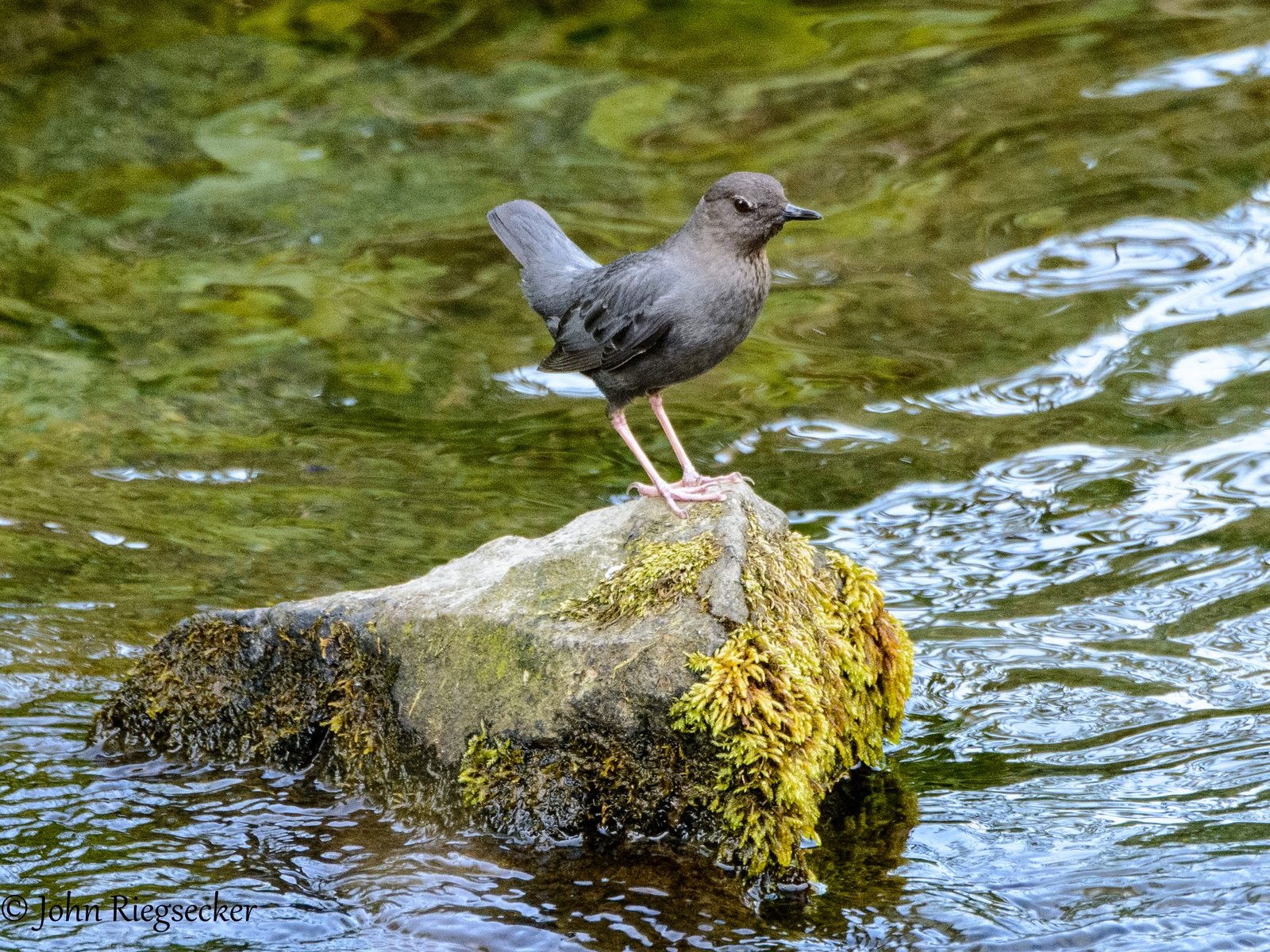
For the first time, I missed Dave the Hatchery Dude on this trip, but as I led us around the back side of the little hatching ponds, I finally got a good look at the Green Heron that has spent the whole year hiding from me pretty well. He was in one of the trees, and stared back at me with his bright yellow eye before taking flight across the river. I was sad that JC and John missed the bird, but we were all rewarded with an enjoyable visit with an American Dipper family. Right on the stream running through the hatchery, dippers had made a nest, and John was able to get some of his best shots of this fun little bird, including adult feeding the young.
Eells Spring Hill Road/Little Egypt Road
 |
| Habitat galore - Little Egypt Road |
Again, the list of hoped for birds was large, time was short, and success was nil. We had bluebirds here in late March, but there was no sign of them as we crested Eells Spring Hill and made our way back down towards Dayton. We had vague hopes for Townsend's Solitaire, House Wren and Hermit Warbler, but the day was getting long, and many birds had simply hunkered down.
Little Egypt Road similarly added no new day or year birds (we were hoping for Western Kingbird, Sora, Virginia Rail or Cinnamon Teal), despite looking like gorgeous habitat. We chalked this up to simply being there at the wrong time of day, although I was still surprised that the rails didn't respond to calls.
Kennedy Creek
 |
| Yeah... there's no mud here. Kennedy Creek at high tide |
See... the thing that really has set me apart in my search for birds in Mason County is how dialed in I am with the tides. I know when the tide is good.. I go there when it's good... I get birds. Except for maybe this time. I have never seen Kennedy Creek so full of water! I realized that we had arrived an hour later than I had hoped, but... seriously??? Some peeps swung around in a circular flight briefly, and a few Canada Geese and Buffleheads hung out in the water, and I decided to call it a day!
We returned to Sanderson Field to swap out cars, and said our goodbyes to John before JC and I went to meet up with the Bisers. We did add Wood Duck and Pied-billed Grebe to the day list for a semi-grand total of 91!
Other detail of the evening shall be wrapped up into the next day: In Which Good New Birds are Found.