Tuesday, February 17, 2015

February Big Day, and finally some owls!


My year so far!  Key:  Black pen lines through the county are from Jan 10/11.  The thin blue lines at top are
from a day trip to Tahuya.  The green is from the post "Owling Weather" although I only added the little bits at Hamma Hamma and on the east side of Case Inlet.  I made a stop at Kennedy Creek (in pink at bottom), and the February 15/16 trips are all in thick blue.   I may have to get another map for new ones!

Big Day Number Two

January ended with my bird total at 85 for the year, and although I felt myself balking at the idea of another Big Day to start February, I rolled up the sleeves and dove in.  After a lovely Valentine's Day with Bre and the kids, I packed and fell asleep.  The internal alarm clock woke me up at 2 AM, and I hopped up, got out the door, made my regular stop at 7-11, and made my way to Mason County.

Why would I balk?  I think with the Big Year in the county going on, there was an internal Rational Tim who suggested that I don't need Western Scrub-Jay or Anna's Hummingbird, so why use the precious time to find them?  At a recent Christmas Bird Count, a birder was venting about the activities of "listers" - birders whose focus is on adding birds to their lists (as I am!), but sometimes at the cost of... enjoyment? science? ethics?   At any rate, after having watched listers out recently chasing a Yellow-billed Loon on Vashon, staying long enough to see the bird, and leaving (whether that was ten minutes or two hours), he asserted, "That's not citizen science!  That's just waving your..."  (I won't finish that sentence, but it was quite a colorful description of listing that would actually be a physical impossibility for women who keep lists.

Long story short:  I want to keep making sure that I have at least one day where I hit a wide range of habitat and work to understand how all of the birds change over the course of a year, not just the birds that I "need" on my year list.  I've been adding my observations to eBird online, and hopefully some of it will be put to good use!

Owls! 


The view up Elfendahl Pass Road - minus the stars
In January, I made a trip over specifically to see owls, with stops that had included some fairly reliable owls - a Barred Owl at Theler, and a Barn Owl at Hunter Farms - and some shots in the dark in an area that seemed like it should be rich with owls - the Hamma Hamma River valley.  I'd struck out on all counts, and this time instead followed a tip from Matt Bartels, who had some success on Elfendahl Pass with Great Horned and Northern Saw-whet Owls. 


I had another great break with weather, with stars above, and not much wind at all.  As I drove up the road, I think I may have mis-followed the directions I was given, but found a nice pull-off with a gated road on the opposite side.  I was expecting either of the two owls mentioned above, but after a little bit of walking got an awesome surprise.  In a copse of trees, I had two Western Screech-Owls (86) responding to the Great Horned Owl calls I was making.  I whispered a "sorry" to them, and listened to the bouncy ball calls, amazed at how soft they are relative to other owls.

Western Screech-owls used to be quite widespread in Puget Sound, but it seems that the appearance of Barred Owls (who eat the little dudes) has put them on a serious decline.  They are still hanging on in some areas (described in earlier posts), but this was not necessarily a place I was expecting them.  I had frankly put this code 3 bird into my "probably ain't gonna happen" list, which still includes Spotted Owls, but it would be equally good news if I encounter any of them during the year.

Continuing up the road, I tried a new spot for the two owls that Matt had suggested, finding Great Horned (87) at some nice "edge" habitat - forest that came right up to a clear cut - and Northern Saw-whet (88) calling from across a lake on the east side of the road.   Three in one night!  I was grinning at all of the owls I'd been able to enjoy and almost felt greedy heading down to Theler Wetlands, where I was sure I was going to get a Barred Owl.


Theler Wetlands, where I was sure I was going to get a Barred Owl


This is the idyllic setting where I heard the Barnshee
Birds are funny, aren't they?  On my third try for this owl, I got a surprise.  After calling for Barred Owl, I got a hair raising screech from a Barn Owl (89) Every hair on my body was on end (and.. that's a lot of hair).  I was a little ways down the path from the parking lot when it screeched, and... I mean, I know what a Barn Owl sounds like... but I had not completely ruled out confusion species, and was still considering the possibility that it was instead a Banshee or something worse coming to take my soul.  It's that kind of a sound. 

This was one of those times where there really should have been a film crew to catch my comical horror.  I walked quickly towards my car and the Barnshee screeched again... was it closer???  I walked faster, and suddenly I heard the twittering sound that seems to have inspired so many horror film soundtracks.  I don't think I ran?  Funny, it's difficult to remember getting there, but I made it to the car and gave myself a minute before laughing it off.   It's easier to laugh from inside the safety of a car. 


I grabbed a nap in the car, then breakfast at Starbucks in Belfair, and I was back to Theler.  I looked cautiously up into the trees as I walked the path.  I had it in my head that it would be good to walk the entire trail as it was just starting to get light, which would let me walk the whole thing once while it was light.  This worked out fairly well - I got a lot of ground covered fairly early, adding Brown Creeper (90) and Bushtit (91). 


Theler waking up
Buds and bushtits
The Bushtits were a nice surprise.   It seems like they are one of those code 1 birds that can be a little tricky, but the bridge south of the vault toilets is apparently a good enough place to find them when they want to show up.  The picture here is horrible, although I kept it because it shows how much the plants are starting to bud.  Spring's a-comin!


Hunter Farms

To be fair, I stopped to look at the salt water a few times on the way to Hunter Farms, including the mouth of the Skokomish  (where I did find a Thayers Gull (92)) and Twanoh State Park, but most of the birds were becoming very... very familiar.  After looking at my billionth Surf Scoter, I wondered in my head.  "How many Surf Scoters do I need to look at before I get a Black Scoter?  Why isn't this a number that is already known?"  I assume it's a big number, and I'd really appreciate it if I could just observe enough Surf Scoters to just roll a thousand of them over and have them count as a Black.  Or five thousand.  I'd do ten thousand maybe if this continues.  I found no rules on this with the ABA, so it may be that I actually have to find one, so I have a feeling I'm going to be peering at a lot of Surf Scoters in the year that remains.

While making some snack purchases at Hunter Farms, I happened across an employee that I had seen on my owling trip in January.  We discussed birds a little more, and I got permission to take a look at their fields.  A Sharp-shinned Hawk (93) sat in a tree above the parking lot.  I walked back behind the parking lot to the path that hunters use when it's allowed on the grounds.  I was excited to see some good sparrow patches, and found some White and Golden-crowned sparrows, but still no Lincoln's in sight.  I'm worried that will be a tough code 3 bird - we shall see. 

Snow Goose                                             Canada Goose
I finally made close enough to the flock of geese to see them take flight, and I found a Snow Goose (94) mixed in.  For the sake of story-telling and continuity, I will ignore the fact that I took a picture of seventeen Greater White-fronted Geese as well!   I didn't look at the picture until Tuesday, when I had seen the same flock a bit more directly. 

Purdy Cut-off

I made another stop through here, pretty specifically looking for Pied-billed Grebe (95), and I was able to find one.  The water was so glassy, and the reflections of the colorful grasses alongside the water turned the reflections beautiful shades for the pictures.  I added Ring-necked Ducks, and Lesser Scaup to the day list as well. 


Skokomish Valley Road

I made some of the same stops as I had in January, although I seemed to find fewer sparrows this time.  The big surprise was the discovery of four Tree Swallows (96) circling over the fields.  It was the first spring bird that I had found during the year, which added to the other signs - bird song, and budding plants - that spring was on the way.  I added a Ruby-crowned Kinglet to the day list, but am still waiting to hear one of them sing their complex song.


And yet... I have posted a worse picture of an American Dipper.  Wow.
I stopped at the Eells Springs Trout Hatchery once more, looking for one of the resident Green Herons.  That was intentionally plural; The same guy has been there every time I've visited (three times now for the year), and he confirmed that he has seen two of them at once.  He had seen them earlier in the day, but a walk of the grounds didn't turn them up for me.  They don't seem to leave, so it's just going to take persistence and/or patience to see one of them.  I voted for persistence, and simply vowed to come back. 

Potlatch State Park was pretty windy so  I looked at three thousand more Surf Scoters, and a gorgeous Harlequin Duck and eased on down the road to...

Shelton. 

I was pretty tired by the time I got to Shelton, and decided to celebrate my exhaustion with a lovely nap in the Taco Bell parking lot.  I woke up in my car, making sure to do that thing I do... you know the thing where I wake up in my car and believe I fell asleep driving.  I wrested the vehicle under my control and steered it back to the parking spot safely before peering around to see if anyone had been watching.  Lunch was lovely. 


Mount Rainier across Oakland Bay
I made it down to the Mountainview neighborhood again, picking up Western Scrub-Jay, House Sparrow and House Finch.  There also seemed to be a lot of  Pine Siskins in the neighborhood.  I drove down through town, and then up Highway 3 along Oakland Bay.  It was pretty enough - not terribly birdy, but I was able to see a few Buffleheads, and a Double-crested Cormorant on the water as I drove towards Latimer's Landing, at the Bridge to Harstine Island.


Harstine Island (also known simply as Harstine or Harstene)


Pickering Passage from Latimer's Landing
That's the name given by Wikipedia, which also goes on to explain how some guy on some boat named it after some other guy on his boat, not realizing that this guy was going to use a few variations on his own name before all was said and done.  So I feel like I've seen four or five different spellings and honestly will invent seven or eight more if I can remember to do it over the course of the blog. 

Most of the view whilst driving on Hawrstean Island
This island had my attention because A) I'd never been there, and islands seem romantic in general, and 2) it extends down south into Puget Sound, providing views of some species that are tougher up on Hood Canal.  I set up my scope on the "mainland" at Latimer's Landing, and scoped  the birds on the far side of the channel.  My attention was first drawn to black birds with obvious white slashes across their sides - Pigeon Guillemots! (97).  As I looked over the cormorants on the far side, I saw several Double-crested before I had a chance to watch what turned out to be a Brandt's Cormorant!! (98).  

Alcids like the Guillemot are one of the main reason I will be making it back to Hartsteine Island in the future, and the cormorants were gracious enough to float around in plain enough view for me - Brandt's is a species that I consider tricky because cormorants are so often in flight, or not always providing a view that allows the bill shape and color to be studied.   It's a code two bird, so not that unusual, but I was a bit relieved to have found one.
Always a good sign
Douglas Squirrel - Squaxin Road
Hahrsteene Island provided some beautiful scenery, even thought I didn't pick up any new birds, with a mix of thick forest and the occasional clear cut.  There were precious few views of the salt water, but I had it on good word that Squaxin Road at the very southern tip had a spur that ended with a view of the water. 


A view of Thurston County from Squaxin Road
I arrived at one of my favorite signs (Primitive Road:  No Warning Signs), and this was certainly the shortest such road I had ever been on.  I parked at the top of it and simply walked down, picking up Varied Thrush along the path, and Purple Finches as two flew overhead giving call notes.  I realized that I really should make this a morning trip.  This spur gives a view towards the west, so I mostly looked at backlit birds.  The numbers were excellent, however, and if I do find out the Surf/Black Scoter conversion factor, I'm sure that this spot will help me towards the 100,00 Surf Scoters I need to see to add Black Scoter to my list.


Crossing sails from Squaxin Road spur

I left the southern tip and drove back to the north end of the island where I made a stop at Jarrell Cove State Park.  I had spent a lot of time on the road and a lot of time staring at birds, and found myself just smacked across the face with the lazy beauty of this place.  I didn't have a tent, and I had a place to stay for the night, so I wasn't able to simply stay, but the place was telling me to.  It was probably around four, and the temperature was nearly perfect, especially for February.  I walked down to the ramp leading out into the little inlet with a view of Pickering Passage, and just enjoyed it.  A grebe floated by at a distance, and I kind of shrugged it off, happy with the birds I'd seen for the day.
Across Jarrell Cove
Haven't had time to look this one up.  What are these?
 
Evening plans

The Bisers at Still Waters Farm had offered me a bed in their barn for the night, and when I called, they were generous enough to add dinner to their offer.  It always feels rude to show up empty handed, so I swung by Grove Street Brewhouse to fill up the growler I had brought along on the trip.  They were technically closed, but had not closed the till, so I lucked out.  I tried two of their beers and settled on a rye ale.  The gal tending the bar filled it three quarters of the way when the tap simply ran out. 

"You could get  me a coupon for a free pint next time I'm in!"  I suggested.  She instead offered another smaller growler of the other beer I had tried.  Now... there was a beer I had tried here in January that was delicious, but a large growler of it would have been too much.  "How about your vanilla stout?".  "Well.. that one costs a bit more.  They use real Madagascar Vanilla in it."  "Well, just short me on that one too!"   This got a hearty laugh and 3/4 of a growler of a delicious beer.  I will definitely be back.

At the Bisers, I added my last bird of the day - Wood Duck, my 78th for the day, and enjoyed a lovely dinner.  The conversation topics mostly swirled around education.  Shelton schools are struggling by a couple different measures, and we had time over the course of the evening to talk about education from a lot of different angles:  The challenges that the kids face, the parents face, the teachers, and even the people paying property taxes, which (while not high compared to the other side of the sound) are a stretch for many in a struggling county.

A sign of hard work
One of the more exciting things that came up was Mark relating stories of field trips that schools took to his farm.  The Biser's had offered their time and property for groups to come through and learn about forest ecology, but there wasn't money to even get the kids bussed up.  The couple paid for the trip themselves and had a whole slew of activities for the students to enjoy the land and learn a little about how the different parts of the ecosystem interact with each other. 

This county seems like it really would benefit from as many science educated kids as it can get.  Between the forestry industry, shellfish farms, and the trout and salmon habitat, there are a lot of opportunities in the future for people to study and improve the water and the land.  From Mark's report, the family that owns the land at the mouth of the Hamma Hamma (and the shellfish company of course) has already been doing amazing work in that regard.  They've worked to improve the steelhead runs along the river, and have been pretty successful in improving the survival rate of the eggs laid there each year.

I finally hit the hay in the barn.  Not actual hay... but I had you for a second there.  They have a fully finished kitchen, living area, bathroom and bedroom that they call "the barn".   It was a very hard sleep at the end of a lovely day.

More to come soon,
-Tim

Thursday, January 29, 2015

Owl Weather

January 26th - "Who wants to go owling?


This is my approach to birding with strangers
My grades were moving along well, and I had a three day weekend, so I took a whole night and a little into the next day to make a serious look for some owls.  My January big day included failed attempts at Great Horned, Barn, Barred, Western Screech and Northern Saw-whet.  I took myself up into the forest roads between Jorsted Creek and Hamma Hamma Campground to look for all of the above (minus Barn, plus Northern Pygmy-owl, and a glimmer of a dream of Spotted!)  The barometer was up, and I did something which has nearly always led me to good people - I posted on Tweeters, "Who wants to go owling?"

I lucked out and got a copilot, Jean Raglund, who was self-described as "not a serious birder", but was a wealth of information for me and good company as we meandered up the forest roads in the early morning.

Forest Road 24-2480

Forest Road 24 leads up Jorsted Creek away from the salt water of Hood Canal in a fairly deep canyon.  I thought this would be a good place to at least attempt to call in a Western Screech-Owl, or barring that, maybe one of those birds that seem to have driven them out of the area.  Nothing. 

It was interesting as we made this first stop that I started to get reminders of how to owl, just from being with Jean.  She almost immediately leaned back against the car and looked up to the surrounding branches for movement.  I rely so heavily on my ears, I forget that owls, every now and then, are a little shy!  Looking at the sky was a pretty good consolation prize, and over the course of the morning, we enjoyed dark, clear skies (for stargazers out there, I'll just say the Beehive was an easy find with the naked eye!), and a handful of shooting stars.

Our next stops farther up were along edge habitat.  FR 24 is cut by several powerlines, and these seemed like good places to try to pick up a Great Horned Owl.  I had seen old tweeters posts that included a sighting of one where the cut crosses the forest road.  Nothing.

After several such stops, we hit slightly more dense forest (although the overstory never got all that thick), where we tried and hoped for Barred and Northern Saw-whet.  When the habitat felt right, we even gave a few NOPO calls, but got nothing but quiet stars in return.  Our final stop was the Hamma Hamma Campground, where we broke our routine of driving a mile and getting out for ten minutes.  Here we walked the campground instead, and got nothing but a really good feeling that owls might like it there.

Hunter Farms


Hunter Farms - I'll be back here for geese and whatnot
The final owling stop was at Hunter Farms.  This is one of the spots in the county that has a reliable Barn Owl.  We got there as the workers were milling around in the sheds, and I let my unshy personality kick in.  I caught one of the guys in the shed and gave a hello, telling him about our efforts to find owls, and a little about my year.  We were lucky enough to get permission that morning to go peek in the barn on the grounds that has had the Barn Owl, and the two workers talked birds with me for a little bit (the Barn Owl has usually been out in the evenings hunting;  there have been geese returning to the valley, and swans on their fields).

Fun, because I couldn't see the rafters at all without the
flash.  Nothing could make a Barn Owl visible.
Jean led the way, tiptoeing into the barn, so that I could see the owl if it flushed, or follow her in if it didn't.   It didn't flush.. I waited for a while before she came back out from the barn.  Empty!  It was eight o' clock.. ish at this point, and the Barn Owl appeared to be out and about!  We gave the rafters one last look, confirming that none of the pigeons were actually owls, before shrugging and heading out the door and back up the highway towards Belfair.


Rock Pigeons - Hunter Farms
At the mouth of the Skokomish, I found a new bird for the year:  Cooper's Hawk (84).  I caught a glance of a raptor that... at one moment looked like it had a white rump... and at another moment looked like it had a red tail... and then I had to let it go.  It was too distant to call it a Northern Harrier, and it didn't come back into view, disappearing to the far side of the delta.  This added to my yearning to get out on the water in a canoe or kayak to paddle around in the delta - what might be out there??  Shorebirds? Raptors? Ducks?

Hood Canal - Union to Twanoh S.P.

We had a long morning of just one more stop.  The first was necessary because of the view:

Hood Canal from Union
We stopped and looked over some birds, and I finally had a chance to return some knowledge.  Handling raptors at Woodland Park, Jean's knowledge of raptors was deep.  Other water birds were new to her, so it was fun over the course of the morning to take a closer look at some birds - grebes, loons, scoters - we looked at them like new birds once more. 

creek outlet into Hood Canal - Twanoh State Park
Twanoh State Park was the next stop (and I found myself saying the name of the park in Keanau Reaves' voice... probably exactly like Ted.)   The birds were close and we continued to pick them over looking for new ones for Jean, and new ones for me.  The clouds combined with the pink of the sky made for a lovely scene.   On three hours of sleep, it felt even more unreal!

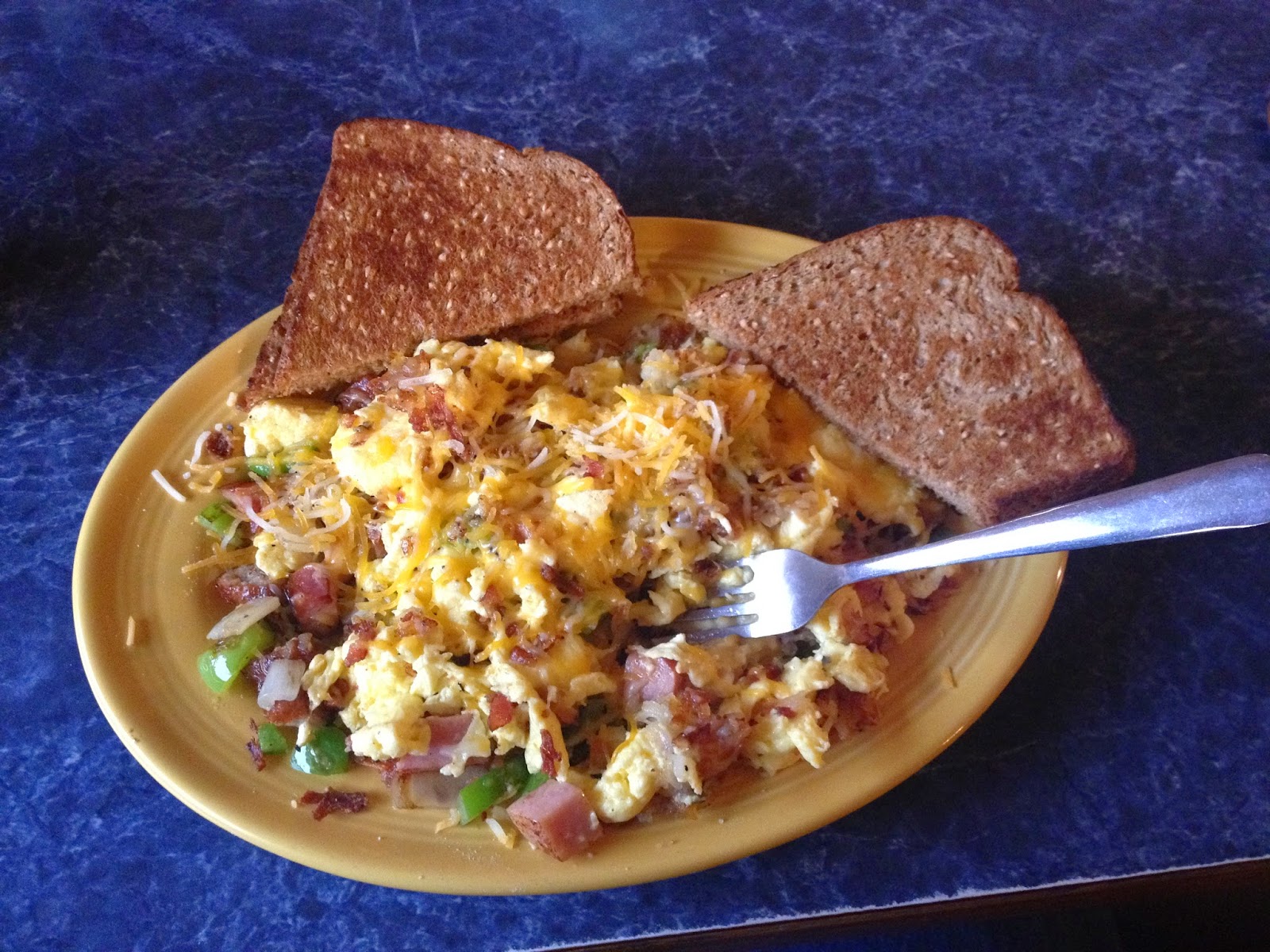
We stopped in at JR's Hideaway in Belfair.  A little coffee and a little food helped wake me back up!  "A little food" was not exactly true.  I had the BBIB (Best Breakfast in Belfair), a mess of potatoes, ham, and other breakfasty goodness. 

BBIB


One More Stop

We made a quick stop at Lake Deveraux, where I was hoping to find a Pied-billed Grebe, but it was gated off!  I was surprised to see a fishing hole closed this time of year on such a beautiful day!

Maybe just one more...

We saw male WWSC too, but the female
had my brain thinking of a Pigeon Guillemot!
Taking the road through Purdy allowed me to look at Puget Sound for the first time of the year in Mason County - Case Inlet was as beautiful as the other stops on Hood Canal, and we found numerous Surf and White-winged Scoters, the White-winged being a life bird for Jean!  I couldn't turn any of the distant birds into alcids, alas, so we continued down Case Inlet until it turned east and into Pierce County, across the Tacoma Narrows Bridge, and home.


Hood Canal Shoreline from Twanoh
 

Sunday, January 25, 2015

Running tally and needs list

I'll keep a running tally of birds I have/don't have here.  Anyone who has ideas on any of those missing birds, feel free to email me or comment below!


Also, I have updated the birds below, as the seasons are changing!  Some of them are here now, some are leaving, and my next trip won't be until at least mid-April I think.

Code one birds remaining:  Birds that should /might be around now  Birds that don't seem like code 1 birds

1. Northern Shoveler
2. Northern Harrier
3. American Coot (Probably not a chance until October!)
4.  California Gull
5.  Swainson's Thrush
6.  Cedar Waxwing

Code 2 Birds  Birds that should/might be around Birds that have me worried

1.  Eurasian Wigeon (I expect this is a miss until the fall comes)
2.  Cinnamon Teal (These might be a three, as it turns out.  The best time to catch them was during my last trip.  Whoops!)
3.  Ring-necked Pheasant (Theler and a second location given by a friend may both have lost their pheasants.  Sanderson Field and Hunter Farms are still options)
4.  Ruffed Grouse
5.  Spotted Sandpiper (but easier later)
6.  Short-billed Dowitcher
7.  Common Murre
8.  Common Nighthawk
9.  Western Wood-Pewee
10.  Willow Flycatcher
11.  Chipping Sparrow

Code Three birds.  They will take planning work and luck


1.  Cackling Goose 
2. Blue-winged Teal 
3. Long-tailed Duck  (they are annual, but there's a lot of water to search!  I have to be patient in looking through distant dots)
4.  Ruddy Duck  (I've already seen some reports)
5.  Lesser Yellowlegs
6.  Long-billed Dowitcher   (I plan to make some of my own luck by getting other birds seen early, so that I can plan on hitting good shorebird spots when there are good tides.  So far so good!  I have a sense that I will miss at least one of these, and that I am just as likely to see some less common shorebird just from happening to be in the right place at the right time.  I hope the Yellowlegs and Dowitcher vocalize...but I'm ready to get pics and study these little dudes to distinguish them from their close cousins)
7.  Parasitic Jaeger  For this and the alcids below, I plan to spend some time looking off of Hartsene.  The south sound is much better for them than Hood Canal)
8. Marbled Murrelet
9. Rhinoceros Auklet
10.  Spotted Owl  (I will make attempts for these owls, but am not holding my breath.  It would be silly not to try for species that are "annual" in the county, but I wonder if anyone even knows where/if there are any remaining.)
11.  Horned Lark (Supposed to be at Sanderson Field.   It'll take time to search. Update in May - the area where they had been may have been reduced, with parking adjacent to it.  No sign of them this year!)
12.  Townsend's Solitaire.   (I don't think that I have in my life sought out a Townsend's Solitaire and found one.  I may be wrong on that, but I think they kind of just find you if you're out there birding enough.  I'm always surprised to see them)
13.  Western Meadowlark.  I feel like I have no idea where I'll find one. 

So if anyone comes across birds from the 2-3 lists (or of course anything more rare!) I'd love to hear about it!  For that matter, a coot or a shoveler would be an exciting report!  I do have a couple of 4's that I'm going to go after.  I will get one or two of the following... it might just be one... but you'll see some interesting attempts on these birds: Golden Eagle, Northern Goshawk, California Quail, House Wren, Common Tern, Red-necked Phalarope.  I'm not banking on any one of them in particular, but I have at least good thoughts on all of them.  We shall see how it goes!  OH!  And I'll get one Code 5 shorebird this year.  I have a good hunch on that.  I'll take guesses on which one.

Happy birding! 

Friday, January 23, 2015

North Mason County - New lines and five new birds

I made arrangements for a sub to take my class so that I could stay home with my daughter, but she got the green light to go to school, so I took the morning to go explore the north part of the county for the morning and early afternoon.

Belfair State Park 
Dunlin in flight - Belfair State Park


This was my first stop, with the primary purpose of the trip being to look for the Marbled Godwit that had been sighted here earlier in the week.   I got out of the car and as I walked towards the car, heard Red Crossbills (79) flying overhead.  I drank in their call notes and swished them around over my aural memory and smiled "Type 3", I said quietly to myself, recognizing these as the subspecies that tend to feed in Western Hemlock.
Link to an eBird article on Red Crossbill types and calls

And here is where I have to explain for the first time in this blog what I think I explained several times in 39counties (www.39counties.blogspot.com):   My ears are pretty good.  By that, I mean I can hear a wide range of notes, can often hear them at a good distance, and do a pretty good job in terms of recognizing familiar and unfamiliar calls.  I haven't birded widely enough or for long enough to know some of the less common vocalizations of birds, or birds that are not common around here.

Now,  I only comment on my ears to highlight another fact.  For a birdwatcher... a birdWATCHER... I'm really quite poor at seeing birds.  I mean this in so many different ways:

1)  Upon hearing birds on field trips, other people often get on the bird.  "Oh there it is!"   What follows is often an awkward, extended effort to get me to see the bird.  It doesn't matter if it is the only bird on the only branch on a lone snag in the middle of an otherwise empty field.  My eyes have a way of filtering out the bird and replacing it with scenery.  

2)  Seeing a bird is not always a good thing for me because my understanding of field marks with many birds is horrid.  I really actually do bird with other people, and as they call out feathers, I ask with interest.  "Where's the petagial whatchahoozit you were talking about?"  "The books always talk about 'mirrors'... show me where those are."    I have had eureka moments where I have connected these words to the physical parts of birds.  I have on occasion even opened bird books and read about the field marks and made a mental note to remember where the lores are on a bird.  But something happens over time, and the information just floats away.  With close birding friends, I will often let them know that they are over my head by talking about the tertials on a bird we are discussing.

3)  Everything else.   By which I mean, for example:  Purple finches don't look that purple to me, which drives people crazy when they are pointing at one and fawning at its gorgeous hue.  Someone once pointed out that a bird we had both seen "Didn't fly like a falcon", and I asked what falcons look like when they fly, exactly.  He got even more agitated than the purple finch people. 
House on the left, Purple on the right.  Not my pics.

Purple and House finch side by side from some fellow's flickr page

All of this becomes magnified when disaster strikes and I see (or think that I have seen) an unusual bird and have to report it on ebird.  "Hi!  I'm emailing on behalf of ebird to get more details on your (insert rare bird here)." the letter usually begins pleasantly.  "You gave absolutely no description of the bird!  could you please describe it and explain how you ruled out other possible species?"   It must be like pulling teeth for these folks.  I'm really going to try to get better at it this year...

Anyway, as I basked in the glory of my ears, I walked out towards the water where the godwit had been seen.  This bird is a code 5, meaning it has been recorded five or fewer times in the county, but this particular bird is almost certainly the same one that has been back for three winters in a row now.  What I know in my heart is that this bird HAD to be there on my big day, and went unnoticed.  The crossbills and the godwit side by side were the perfect snapshot of my skills and lack thereof. 
Dunlin like this much exposed mud


Marbled Godwit - note the diagnostic view of the tertials
(please read above before analyzing that statement)
It was a bit drizzly, but the tide was good - somewhere around a 10, and I felt like I was getting a good feel for what a good tide was at Belfair.  The hundreds of Dunlin were wheeling around the estuary again, and Hood Canal was full of the same suspects:  Common and Red-breasted Mergansers, Northern Pintails, Greater Scaup, Surf Scoters, hundreds of Brant, grebes, and gulls.  I scoped slowly up the far side of the emptying river, and eventually found the... well I won't bother trying to describe the color.  Are they brown?  golden?  buff?  See my notes above, but the Marbled Godwit (80) was there, bicolored bill easily seen.   I smiled at the success, knowing that each code 4-5 bird I find this year will make the whole endeavor much easier.


New lines

Bre and I had travelled to every county in the state together.  One of our first dates was a road trip to see seven lighthouses in a day.  We survived the road trip pretty well, and I traced our trip into my big Washington gazetteer.  I kept doing it, and it led to the question "What counties have we not been to?"  We found reasons to get to different counties, and eventually saw all of them together, tracing new lines on the map each time.  We still get excited when we hit new lines together. 

The county birding thing has taken me to a lot of little roads in all corners of the state, but I realized as I left Belfair State Park and took a left that I was driving on new lines. *tingle tingle*

New lines for today in purple
Wildberry Lake was my destination.  I had read a post from the loquacious Jeff Gibson on Tweeters about Gray Jay and Sooty Grouse being year round residents at this plateau above Hood Canal on the Tahuya Peninsula.   There may be easier opportunities to see these species later in the year, but I thought I'd at least scout it out and explore an area that was a little off the beaten path. 
The Tahuya Peninsula is the land that is being given a 'hug' by Hood Canal.  It has some State Forest Land, and seems to be the area that people return to each year in their desire to add Mountain Quail to their year list.   They don't seem to be very vocal until March, and are rarely out in the open, so I had no expectations of seeing any today.  As I drove Belfair-Tahuya Road, I passed a few lakes and gave three of them a good look.  No coots.  Just saying.


The big clear cut here is just west of Tahuya-Belfair Road, almost
to Tahuya.  The red pin is Wildberry Lake.
I got to the turn off for Wildberry Lake, and clearly did not follow the road far enough, in retrospect.  I saw from the satellite view of the area on my phone that there was a large open area to the south of the road, and decided to investigate.


This clear-cut was full of newly planted trees, and snipe!
Now, clear-cuts are supposed to make me tear up, I think.  I know that all of them must once have had enormous trees and very different ecosystems flourishing than what we have today.  Nonetheless, the different birds that show up in this kind of habitat makes it an interesting one for me.  I pulled into the clear cut and pulled into an open area in the middle of the random crisscrossing of dirt roads through the rolling bumps of the cut.


It was time to eat, so I pulled out my sandwich and walked.  A nearby crest seemed like a good spot  for viewing the area, and as I reached it, I flushed a Wilson's Snipe (81).  I was a little shocked, and decided to keep walking to the next crest, and as I did, I looked down to a little pond below.  "oh!"  I said, and my voice brought a dozen more snipe into the air, flying away to some puddle on the other side of the cut, I'm sure.  My little walk brought me back around to my car, with one more snipe flushing from another wet depression.   No Gray Jays or Grouse, but I know better where to look next time, and the time of day will certainly make a difference.

Tahuya

Western Hemlock - Tahuya Peninsula
I finally got to the Tahuya end of Belfair Tahuya Road.  This part of Hood Canal is much like the other side - lots of privately owned beaches, and peek-a-boo views of the water between the houses lining the fjord.  I made numerous stops, regrettably with a dead camera battery, finding Common and Red-throated Loons (but no Pacific), White-winged and Surf Scoters (but not Black), Horned, Red-necked and Western Grebe (but no eared), Pelagic and Double-crested Cormorants (but no Brandt's).   So... a lot of the birds I'd already seen, although many of the views were spectacular, especially for the Red-throated Loons and White-winged Scoters, which were quite close. in.  One more new bird came during this drive, with a pair of gorgeous Harlequin Ducks (82).

I made the quickest of stops at Theler before heading home and found an agitated flock of small songbirds, including a Hutton's Vireo (83), although I never happened upon the raptor or owl that surely was responsible.

That's all for now!


Tuesday, January 13, 2015

Aftermath: 68 plus 10


Good Morning, Shelton!
 
Next day birds

I hate to be a broken record on this point, but I will be adding other posts to talk about my evening watching the Seahawks play Carolina with the Shelton locals, about my stay at the Shelton Inn, and my breakfast at Blondie’s Restaurant. The “other stuff” really is going to be a big part of this blog, but to do it right, I’m going to focus on the birding in this post.

1.  Do scrub-jay families use blue eye filters?
2.  Am I really going to take pictures of people's houses?
(I won't make it a habit.)
After sleeping in (I rarely do this on birding trips), I walked the Mountainview area of Shelton.  Ebird has a lot of pins dropped for Western Scrub-Jay, Eurasian Collared-Dove, and Anna’s Hummingbird in this neighborhood between I and M streets, so I parked at Jefferson and J, and walked a block.  Western Scrub-Jay (69) popped up for me right away, and I eventually found a hummingbird feeder with an Anna’s happily feeding.  With those birds in the bag, and with a neighborhood dog barking fairly incessantly, I decided to head out.  I had planned to go right to the Skokomish Valley for missed birds, but as I headed up 101, I saw the Fairgrounds/Sanderson Field and had to make a stop. 

Sanderson Field

Sanderson Field is interesting habitat.  I was hoping for a good hawk or harrier cruising the open fields, but they were pretty quiet.  I walked in to find a trail through the fields and Scot’s broom south of the field.  Pacific Wren, Bewick’s Wren (70), Fox and Song Sparrows, and Spotted Towhee were found in the dense brush, and a Steller’s Jay was found in the more wooded area as I continued down the path.  There are reports on Tweeters of California Quail from this area, and it was very tempting to continue down the path, but I resisted the temptation for now!

I really do plan on walking a long ways into that stuff some time.
Skokomish Valley

Falls emptying into S.Fork Skoke.
Side trip - High Steel Bridge
I returned to the grange, wanting a better look at the swans I had seen the previous day, but they made no appearance.  A second attempt at the Green Heron also failed.  This time around, however, I was able to find a gull that finally left me feeling good about Herring Gull (71) for an ID, and an easier ID on a Ring-billed Gull (72).  I also found sparrows I had missed the previous day, with great looks at Golden-crowned (73) and a large flock of White-crowned (74).  I swear I heard a Lincoln’s Sparrow call.  It made me stop the car, and I heard a few intermittent calls – kind of a smack…but not as hard as a Fox Sparrow, or even (I thought) a Junco.  I couldn’t trace the calls to the source, though, so I had to let that one go.

Purdy Cutoff Road

Here I was again, looking over this little slough, and I stopped the car very early for some swans!  I have the picture here, and once people get a good look at them, I may decide to call one of these a Tundra Swan.  There is no yellow in the bill, which would have been helpful, but the dark of the bill meets at a smaller point at the eye for the middle bird (and maybe one or two of the other birds, but I like the middle one!).  If I do get an ID on this, I’ll add it numerically after the others on my list.  Nothing else new here.
Swan number three has a nice head shape, and narrow black lores, but... If I'm calling it a tundra, it's hard to figure out why it wouldn't be as white as the Trumpeter Swans in front of it?  Also, I just didn't realize that swans even this far into the
year would be that short of full size.  This was a tough one for me to let go, but for now, I'm ready to, unless someone adds new information. 
 
Skokomish Delta

Red-breasted Merganser - Hood Canal
Mark had suggested that there might be a lot of American Coots at the mouth of “The Skoke”, so I was pretty excited, as that species (a Code 1???) seems to be a headache for most county birders.  This day was no different than any other for me in Mason County in that regard – no coots!

At the mouth, I did have a lot of waterfowl, including my first Western Gull (75 – finally one with a dark mantle and a nice clean white head), Red-throated Loon (76), and several Gadwall (77) further into the estuary.

Goldeneyes, White-winged and Surf Scoters, Common Loons, American Wigeon, Horned Grebes –all were hanging around the mouth of the Skokomish in high numbers.  I went farther up the Canal for one last stop at a view point in Union, where I added the last bird on my list for the weekend – a Western Grebe (78).

Birds I didn’t get:

I feel like I left a lot of good birds out there on the saltwater:  Black Scoter, Long-tailed, Harlequin and Ruddy Duck, Northern Shoveler, Eurasian Wigeon, Cackling Goose, American Coot, Pacific Loon, Pied-billed and Eared Grebe, Clark’s Grebe, Brandt’s Cormorant, and all of the Alcids.   Thayer’s Gull may show up in some of my pics with a little time, coffee and help.

In the farmland, and interesting goose (cackling, greater white-fronted, snow), or sparrow (Lincoln’s, white-throated, Harris’s), or blackbird (Rusty, yellow-headed, or maybe a Western Meadowlark), or raptor (Northern Harrier, Cooper’s, Sharp-shinned, Rough-legged Hawks, or a Merlin) would have been nice finds.  A Northern Shoveler could just as well have shown up out there.

Lil’ birdies:  Brown Creeper, Red Crossbill, Bushtit, American Goldfinch, Yellow-rumped Warbler (or any other more interesting wintering warbler – most of which would show up in the summer). 

Theler birds:  Hutton’s Vireo, Red-breasted Sapsucker, Wilson’s Snipe, Hairy Woodpecker, Virginia Rail and Barred Owl are all regular visitors to the park and could have been found on this trip.

Green Heron.   Gotta get that guy.  I will.

Band-tailed Pigeon.  They’re around.  I’ll see some.

And notably:   I got not a single owl, nor a single gamebird.  That’s got to change!

February will have another Big Day, although I may change up the path and locations to target some of the birds I’m missing.  I’m going to miss some birds anyway!  May as well change up the ones I get, and still try to mix up the settings.  Saltwater can be found in other places besides Hood Canal – It might be nice to get to Hartsene Island, or Kennedy Creek.  Farmland out by Matlock might be good to check, as it’s not birded as often, and could bring me past Lake Nawhatzel where American Coots are sometimes found.  Some of the wooded parks in the west end of the county might be better for Band-tailed Pigeon or (if I got to slightly higher elevations), Sooty Grouse and Gray Jay.

It will be interesting to see how things start shaping up – I’m sure that sightings between now and then will affect my path, and I may change plans a little during the day anyway!

Until that next post, happy birding, y’all!